Taking a trip back in time at Shanxi
|
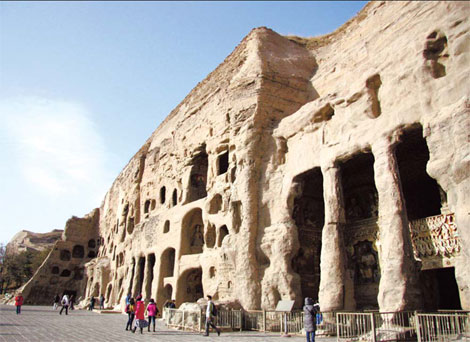
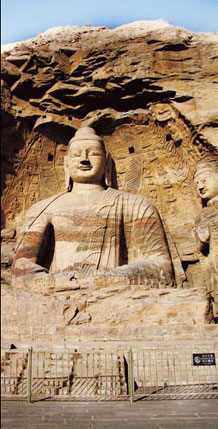
Yungang Grottoes offer a fascinating excursion in Shanxi province. [Photo/China Daily] |
The Hanging Monastery and Yungang Grottoes are only a train ride away for Beijingers with itchy winter feet, Shannon Aitken discovers
It's hard to believe that a visit to Shanxi, two provinces away from Beijing, could qualify as a destination for day trip.
But with only 270 kilometers between Beijing's CBD and the city of Datong, in Shanxi's northern-most point, it's just a four-hour train journey by day.
A journey to one of China's greatest coal suppliers, Datong, is not exactly an escape to Mother Nature. It is, on the other hand, a place to immerse yourself in history, with two very different awe-inspiring sites - the Hanging Monastery (Xuankong Si) and Yungang Grottoes (Yungang Shiku).
On a whim, a few friends and I decided to take a trip to see these two pieces of history. Short on time, we chose to do it all in 24 hours.
|
A massive Buddha at Yungang Grottoes, carved into the side of a mountain. |
That night, we boarded the midnight train - slower than the day train - headed west from Beijing to Datong, grabbing a few hours of sleep before rolling in at about 6:30 am.
Admittedly the drop-off time was a little early, but we killed an hour or two with breakfast at a local dumpling house. Then, after haggling with a local taxi driver for the use of his services for the day, we were off.
First stop was the Hanging Monastery, an impressive wooden structure built in AD 491 that clings precipitously, 50 meters above the ground, to the west face of the Jinxia Gorge.
Though about an hour's drive from the city, the monastery is a well-advised first destination. Despite the modest size of the building, "crowd control" has little meaning here and by about lunchtime the squeezing crowds resembled something of the stampedes on Line 1.
The monastery's ability to withstand the crowd is testament to its unusual ancient architecture. Crossbeams are buried deep into the rock and the mountain provides an unflinching spine.
With such a sound and sheltered position above the ground, the monastery has survived wind, snow and rain, albeit it with a few touch-ups, for more than 1,400 years.
Besides its architecture, the monastery is also unique for its collection of religious artifacts. Among its 40 halls and cabinets, it houses sculptures and carvings of Buddhism, Taoism and Confucianism, which make an unusual mix in the one location.
Made from stone, copper, iron and terracotta, the approximately 80 sculptures are colorful and, thanks to the wear of time, sometimes a little eerie.
Less than two hours later, it was back to the waiting taxi and on to Yungang Grottoes, just 15 km from the city center.

Yungang Grottoes are a World Heritage-listed collection of 53 caves that punctuate Wuzhou Mountain and which contain more than 51,000 carved statues.
Some of the statues are as small as 2 centimeters, while the largest, a statue of Sakyamani in cave 5, is a lofty 17 meters high.
Construction of the caves first begun in AD 450 at the time of the Northern Wei Dynasty (AD 386-534). The varying styles of the caves and their statues show the changes of Buddhist art in China over time, from Indian and central-Asian influences through to Chinese influences.
The sculptures were also unmissable reminders of the day of the emperor's divinity. The largest caves, caves 16-20, known as the Tan Yao Caves, contained Buddhas that represented Emperors Taizu, Taizong, Shizu, Gaozong and Gaozu.
So grand and powerful are the stone carvings that it can momentarily feel like something out of an Indiana Jones film. Towering Buddhas rise above visitors, so large that their faces can only be seen through open second-story windows in the cave.
Stretching for about 1 kilometer from east to west, the mountain on one side, landscaping on the other, Yungang Grottoes feel relaxed and spacious.
And while many like to suggest certain caves as "the best" ones to see, a two-hour visit will give you plenty of time to see them all before the journey back to Beijing.
|
The Hanging Monastery, seemingly balanced on the face of a gorge, is strong enough to handle great crowds of tourists keen to take in the view. |