Fresh pastures
 |
|
A group of volunteers stand in a line, passing buckets of water, to nurture the newly planted saplings in Horqin Grassland, Inner Mongolia autonomous region. Zhang Qianli / for China Daily |
A diverse group of foreigners descends every August on the Horqin Grassland, Inner Mongolia, to try and halt its growing desertification. Xu Lin reports.
It's a sweltering afternoon in mid-August. In a repetition of an annual ritual, a group of people from countries as diverse as Japan, Singapore and the United States, are standing in a line, passing buckets of water, to nurture a row of newly planted saplings in Horqin Grassland, Inner Mongolia autonomous region.
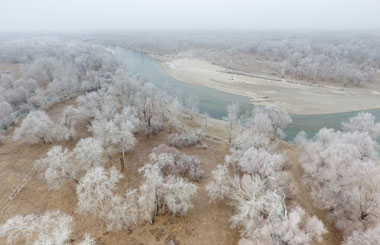
The desertification of Horqin, one of the nation's largest grasslands, began in the 1980s, due to a growing population and the increased grazing of domestic animals.
More trees were chopped down and warmer winters and less rainfall compounded the problems of a land already susceptible to strong winds.
In spring, the wind spewed tons of sand to as far as Japan and South Korea.
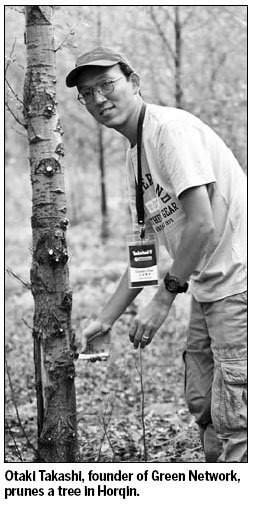
"When I first came in 2000, it was just a vast desert with big dunes, but now it's a sandy land with green plants," 37-year-old Otaki Takashi says in fluent Chinese. He is the general manager of Green Network, a Japan-based NGO dedicated to afforestation, which started the green project in Horqin in 2000.
The NGO has planted more than 3.5 million trees in Horqin, covering about 1,800 hectares of sandy land.
Otaki established Green Network's branch in Horqin Left Wing Rear banner 11 years ago and never left. He married a local ethnic Manchu woman in 2007 and now has a son. The branch has 10 locals, in their early 20s, working for it.
At first, only two villages were willing to cooperate, but now there are 16, comprising about 5,700 villagers.
The trees belong to the locals who own the land. The NGO offers money to buy saplings and tools, and to drill water wells, while the villagers do such work as watering and pruning the trees, for free.
"We've planted more than 10 kinds of trees but their maintenance calls for a lot of money. We hire local villagers as forest rangers and sometimes pay the locals to take care of the trees if it's harvest time," he says.
He says his emphasis is more on educating the locals, to make them aware that these are their trees and they should be responsible for them.
"It takes time to change attitudes. But they are aware of the importance of tree planting and have become critical of those who cut down trees," he says.
The afforestation drive has not only reduced sandstorms, but also improved the lives of the locals. The cattle herders cut weeds and feed cows and sheep and use the pruned branches to make fire. During the slack farming season, the women gather mushrooms in the forests to sell.
Han Yu, 54, a Mongolian from Horqin's Wafang village, says, "In my childhood, we could see many trees and animals, such as rabbits, badgers and foxes, here. My father would go hunting and come home with a full load of them. But I haven't seen a wolf here in years.
"It used to be difficult to keep my eyes open during the sandstorm season but the situation has improved, and some animals are coming back," Han adds, puffing on an old pipe.
Most volunteers are foreigners who work four days a week to plant the trees, and water and prune them. They have to travel for an hour in an open truck on a bumpy road to reach the desert.
"I've organized my company employees to work here for three years, and planted about 300 trees on my own. It's important that everybody does something to make the environment better," says Robert Igabille, regional retail operation manager from Timberland, a US-based outdoor footwear and clothing company.
As one of the NGO sponsors, the corporation has helped plant more than 1 million trees in Horqin since 2001 and sends its employees here every year for volunteer work.
"When I first came five years ago, there was no Internet access in the hotel, tap water was yellow and food was too salty. We just dug a hole to use as a toilet. But conditions are getting much better, " Igabille says.
The villagers were initially suspicious of these uninvited foreigners holding shovels.
"There were a lot of rumors; some said they had come to occupy our land, and to exploit oil and plant trees for profit," Han says.
Otaki found his own way of bonding with the locals, most of whom are ethnic Mongolians, known for their love of liquor.
"We became friends after drinking together. They are very hospitable," he says.
He recalls how the locals would ask, "Have you eaten yet? Please come and eat at my home". He never refused, for fear of losing their friendship. Sometimes, he would end up feeling sick from overeating.
It was only much later that he realized it was just a common Chinese greeting, and not really about having meals.
"When the villagers are ready to plant trees on their own, we'll move to another place to continue our work," he says.