Where the last emperor last ruled, in name only
 |
|
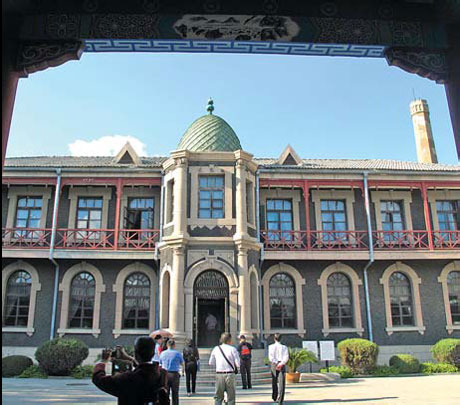
Changchun palace is a hybrid of traditional Chinese and Western styles. Raymond Zhou / China Daily |
The third time's a charm - or so the saying goes.
But for China's last emperor, the third time turned out to be a curse.
Puyi (1906-1967) ruled as emperor three times.
The first was in 1908, when he was not yet 3 years old. He was essentially snatched by eunuchs from his mother and taken to the palace. His wet nurse was the only one from his family to accompany him.
The 1911 Revolution ended that brief reign.
In 1917, the warlord general Zhang Xun restored Puyi to the throne. That lasted only 12 days, a period marked by a bomb being dropped inside the palace compound. But Puyi stayed in the Forbidden City until 1924, when another warlord expelled him.
The Japanese wanted Puyi to be emperor of a puppet government to cover up their invasion.
Puyi, for his part, probably thought he could outmaneuver them.
But he was not even allowed the title of Emperor of China or Qing Emperor but rather "Emperor of Manchukuo", which existed from 1932 to 1945.
When you walk through the corridors in Changchun's Museum of the Imperial Palace of the Manchu State, you can almost feel what was eating away at the young man who was - by birth - thrust into the storms of history.
The architecture in this 137,000-square-meter compound is a hybrid of traditional Chinese and Western, with a tinge of Japanese thrown in. It replaces the grandeur and apathy of the Forbidden City with something more homey and manageable.
However, Puyi soon learned he could not be the master of his own home. Everything, even a walk around the town, had to be vetted by his Japanese handlers.
According to my tour guide, Puyi vetoed some of the documents submitted by the Japanese-controlled staff in the first year, but they kept on reappearing, sometimes under slightly modified titles.
He realized it was futile to try to assert his authority, which was non-existent in the first place, and started rubber-stamping everything sent his way.
He must have known what all this meant as he burned all the paperwork before the Japanese surrendered.
The origin of the Changchun palace was a building with indoor plumbing - a rarity at the time - that belonged to a government office overseeing salt sales. The Japanese started constructing more after Puyi moved in.
But he was vigilant.
He refused to move into Tongde Building after it was completed in 1938 because he suspected it was tapped.
Like the Forbidden City, the Changchun palace was divided into an inner court and an outer court. The formal room for receiving foreign dignitaries was rarely used, as Manchukuo was recognized only by Japan and the Axis countries.
A banquet hall was converted into a small theater where documentary films about the war were the regular feature. Puyi had the strange habit of neither wanting to be alone nor being seen by others while watching movies. So others had to arrive and depart with the light switched off.
Puyi's favorite room, it is recorded, is a room inside Tongde Building where he gathered his royal relatives in celebration of traditional holidays, such as the Mid-Autumn Festival. During the later years of his so-called rule, he started training some students in sharp shooting - in the corridor.
In the residential part of the compound is a small garden with rockeries and a pond. It would pale next to any of Suzhou's gardens.
What stands out is a brand new locomotive, which must be a replica, as the track used to run straight into the compound. The stable and horse track have also been reclaimed or rebuilt.
On the compound's edge is a new building dedicated to preserving the history of Japanese aggression and atrocities in Northeast China. It is free to the public.
The Eight Major Bureaus of Manchukuo, built in the early 1930s, line the city's main boulevards and are now used as schools or hospitals.
Chinese have a superstition about visiting historical sites. We like to believe the winners' auspiciousness can rub off on us.
But Puyi was repeatedly on the wrong side of history, and his Changchun palace is a symbol of that misfortune. He must have been aware of it and have felt like living inside a crumbling tower, at least in the last years there.
The palace, now meticulously renovated, is certainly devoid of any trace of crisis. It takes a leap in imagination to understand how jittery it was for its master to spend his days of virtual confinement in a mansion of early 20th century majesty.