Time traveler
 |
|
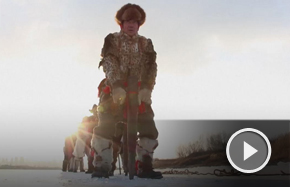
From top: Visitors can easily get lost in the maze-like Benzhai, one of the best-preserved ancient villages in Yunfeng Tunpu; Dancers wearing masks perform dixi opera at the entrance of a local museum; Local women still wear traditional attire. The kerchief is a symbol of marriage; Silversmith Yang Shengyi shows his prize-winning work. Photos by Wang Kaihao / China Daily |
Eight villages in Guizhou's Anshun have changed little from when they were frontier posts 600 years ago. Wang Kaihao reports in Guizhou province.
As our car approaches Yunfeng Tunpu, a cluster of eight ancient villages in Anshun, Guizhou province, I feel like we're traveling back in time to 600 years ago.
Every village looks like a fortress built of stone. Women clad in blue robes and kerchiefs walk by the muddy road. They're Han descendants who first settled here during the Ming Dynasty (1368-1644).
When 200,000 Ming soldiers set off from Nanjing - then China's capital in coastal Jiangsu province - and conquered Guizhou in 1381 after defeating the Mongol army, they did not return home.
Zhu Yuanzhang (1328-98), the first emperor of the Ming Dynasty, ordered them and their family members - most from eastern China - to establish fortresses and defend the southwestern border of the newly built empire. Thirty percent of the soldiers remained on all-day military duty, and the rest farmed most of the time, preparing for war.
In the following decades, 2 million more people from East China were relocated to this area to develop the economy. These migrants didn't marry locals and lived within their neighborhoods, called "tunpu".
The history of these age-old communities is highlighted at a small museum, where I made another discovery.
At the museum's entrance, four dancers wearing masks perform dixi, which literally means "the opera on the ground".
Ming soldiers would perform operas before fighting to improve morale, with a gong and a drum used to recreate the sounds of the battlefield.
Our first stop in Yunfeng Tunpu is Benzhai, one of the best-preserved tunpu villages.
"Where are you from?" Quan Yanfen, a 25-year-old guide, asks me with an accent that, to my astonishment, is similar to my own. I'm from Nanjing, more than 1,800 km away.
Quan wears the traditional dress but without a kerchief.
"The kerchief is symbol of marriage," she explains, shyly. "I am still single."
While millions of Chinese women in ancient times bound their feet - a status symbol that allowed them to marry into money - women living here never followed the tradition. Instead, they wore a kind of pointed, embroidered shoe, which made their feet look slim. Some of these shoes are now on display at the museum.
Unlike the women who continue to wear traditional attire, the men mostly wear contemporary clothes.
"Men are more changeable. Don't you think?" Quan jokes.
Walking around the maze-like village, it's easy to appreciate how an outsider can get lost - and how likely an invader would meet his doomsday in this fortress, with its highly developed security systems.
Seven watchtowers overlook the village. Inspection holes can be found everywhere, functioning like latter-day closed-circuit television monitors. Every house is linked with secret passages, through which residents can move around and exchange messages.
I meet 40-year-old Yang Sheng-yi, a 17th-generation silversmith. He stops his work and cordially shows me a silver decoration, which won a prize at a province-level competition. His son is sleeping in the bedroom, and Yang says he expects the boy to carry on the family's tradition of craftsmanship.
"But I will also respect his choice of a future job."
Though official figures show nearly 1,000 people live in Benzhai village, many locals, especially men, have found employment elsewhere.
Perhaps as a result, the village doesn't have the hustle and bustle of modern civilization or the bars and karaoke joints other ancient villages and towns have.
We continue our journey, uphill, to Yunshantun village, where merchants used to set up home in order to avoid flooding.
The village's main street retains elements of its past: The gateway was built in the Ming Dynasty, while the middle section was formed in the Qing Dynasty (1644-1911), and some Western-style villas were constructed during the Republic of China (1912-49) period.
The moon-shaped village only has two accesses points. Once the two gates are blocked, it would have been almost impossible to invade, so it would have been a safe place for rich merchants to preserve their properties, even though there is no gun port or watchtower.
I sit in front of a stage built in the Qing Dynasty, expecting another dixi performance. However, I'm told the "opera on the ground" cannot take place on the mountain slopes. Merchants in the old days gathered here to enjoy Peking Opera or other kinds of operas from their hometowns in East China.
It's a little bit disappointing, but I make up for it with a spicy chop suey hotpot to end my journey.