Making science pop
 |
|
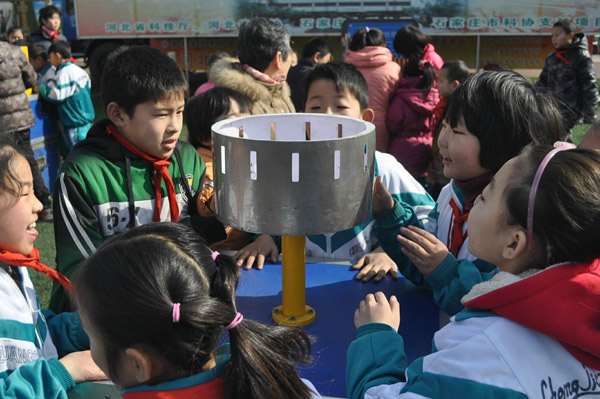
School kids are fascinated by the exhibits brought by Qin Ruiqiang's mobile science caravan, at a school playground in Zhengding county, Hebei province. Provided to China Daily |
 |
|
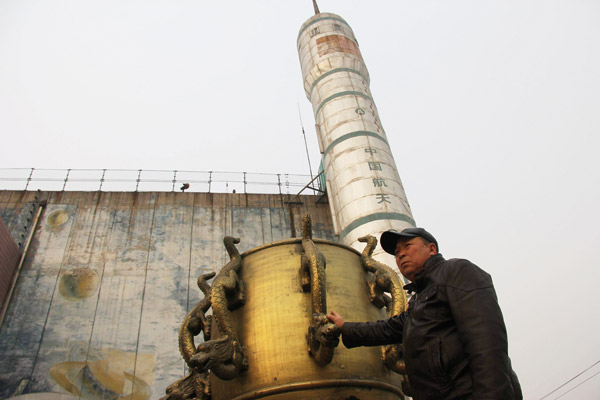
Qin Ruiqiang says he sees hope for the future despite meeting with difficulties running his science museum. Wang Ru / China Daily |
A tycoon plunges his entire fortune into the country's last private science museum but is struggling to keep the doors open. Wang Ru reports in Beijing.
Qin Ruiqiang was the richest person in Zhengding county, Hebei province, until he sold his coal mine, transport businesses and Mercedes limo and invested his entire fortune into the country's last private science museum. The 52-year-old's 18,000-sq-m museum, converted from a cinema, spun money from its 2000 opening until 2003, when SARS kept people in their homes. An even bigger blow came in 2006, when new rules stopped schools from organizing outings because of safety concerns.
While the museum is celebrated in the county of half a million people and the street it's on was renamed "Science Museum Street", fewer than 20 people visit a day.
Qin spent 10 million yuan ($1.6 million) to buy the cinema, including the previous owner's debts, and must pay 300,000 yuan a year to keep the doors open. Group tickets cost 10 yuan.
He spent another 10 million yuan to buy most of the more than 10,000 exhibits. Others were donated by science museums in Beijing.
The museum's displays range from popular science to folk culture. Its roof is crowned with an astronomical telescope. It features thousands of insect specimens, old-fashioned cameras and recreations of rainforests, replete with taxidermy specimens of large animals such as bears and leopards.
One hall displays colorful ores, while another contains ancient agricultural implements, including a rare water wheel. And, of course, there is a cinema.
The China Association for Science and Technology (CAST) named the museum "the national base of science popularization" after designating the third weekend of every September as "National Day of Science Popularization" in 2005.
But Qin, who was appointed as the county's deputy tourism director in exchange for his investment, didn't receive outside support for the museum.
"I had to borrow money from relatives and neighbors to pay my employees and other fees," Qin says.
"Sometimes, I'd even have to borrow 500 yuan."
In 2007, the former multimillionaire found himself penniless. He sold his house, Mercedes and all of his businesses but remained in debt.
But in a never-say-die move, he innovated. "I decided that if people don't come to the museum, I'll bring the museum to them," he says.
Qin bought a container truck and transformed it into a "mobile science caravan", which transports exhibits to show at schools.
In 2009, he designed and built a "mobile astronomical telescope", which is affixed to a van and extends using four hydraulic jacks. Qin patented the invention.
The former tycoon never went to college but has always loved astronomy. He drives the van to observe stars with astronomy lovers. He drove more than 900 km to Hubei's provincial capital Wuhan to observe a total eclipse last year.
He also takes his science caravan to commercial events, such as shopping mall displays and real estate developer's promotional activities.
Qin also drives his old Buick to meet provincial science and technology association officials to request funding. They've started to offer piecemeal assistance.
Qin says he sees hope for the future. His became the country's last private science museum after Desheng Science Museum in Yantai, Shandong province, closed last year.
Desheng's closure came after that of Nansha Science Museum in Guangdong province in 2010. Nansha had been financed for 11 years by Hong Kong real-estate tycoon and philanthropist Fok Ying-tung.
Chinese Academy of Sciences professor Li Daguang, who has conducted five surveys of China's scientific literacy, believes the country isn't ready for private science museums.
"Qin's museum is a unique case that's hard to copy in China's current science popularization system," Li says.
"There's little room for survival without funding and supportive government policies, which are the only source of finance for science popularization."
Qin says the most precious part of his collection is the mass of students' letters and diaries.
"Every time I read the letters or see the excited and happy faces of students at my science caravans, I feel I'm doing something meaningful," Qin says.