Tourists flock to region's popular Sheep Hotel
 |
|
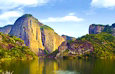
People stand on the bank of the Nam Co Lake, the highest saltwater lake in the world, in Tibet on Aug 8. Purbutashi / Xinhua |
 |
|
A train travels along the Tsonag Lake, one of the highest freshwater lakes, located in northern Tibet. The Qinghai-Tibet Railway linking Lhasa and Xining, Qinghai province, became fully operational in 2006. Xinhua |
Atar's Sheep Hotel, near the Nam Co Lake in Tibet, is a favorite of tourists with a catchy name that is easy to remember and its allusion to a time-honored tradition that is hard to forget.
Atar picked the name "Sheep Hotel" because Tibetan worshippers circle around sacred lakes, including the Nam Co, during the Year of the Sheep in the Tibetan calendar.
Buddhists believe their pilgrimage and walking around the lake during the Year of the Sheep brings good fortune. The grand festival, with a huge gathering every 12 years, was last celebrated in April 2003.
Nam Co, or "heavenly lake" in the Tibetan language, is in Dumxumg county, Lhasa. At an elevation of more than 4,700 meters, it is the world's highest saltwater lake.
The number of tourists began to multiply during the 1990s because of its picturesque scenery and deep-seated religious culture.
Atar, now 54, was the first in her native herding village to seize the opportunity.
She started by offering basic accommodation in black tents made of yak hair. Eight people at most stayed in a tent. Her business grew and received a major boost in 2006, when the Qinghai-Tibet Railway linking Lhasa and Xining, Qinghai province, became fully operational.
She invested 800,000 yuan ($128,000) in 2009 and built the Sheep Hotel, which covers 2,000 square meters, with 39 rooms and 156 beds.
Today, the hotel has expanded to house 78 rooms and 300 beds, complete with a large restaurant and two vans used to transport tourists. The restaurant now serves Western food, local cuisine and delicacies from other parts of China.
"It's not easy, in such a remote place," said Johnn Robertson, a tourist from New Zealand. "On the top of the world, we can have our home food. It's delicious, and we also enjoy eating Tibetan food as well. It's very fresh and nutritious."
Atar's family used to have a small number of cattle and earn less than 8,000 yuan a year. Now the hotel, restaurant and transportation businesses altogether receive 300 guests a day and bring in 500,000 yuan a year on average.
Atar hires 11 local nomads, paying them between 900 yuan to 1,600 yuan a month. Nearby villages also have smaller inns.
Tourism has benefited the entire Nam Co township population. About 60 percent of the herdsmen there make an extra family income of 20,000 yuan to 30,000 yuan a year by selling local specialties such as yogurt and highland mushrooms during busy tourism seasons, Atar said.
But the downsides are air pollution and noises caused by construction projects near the lake, and more garbage on the ground, she said.
In recent years, Atar delegated more responsibilities to her 22-year-old son, Gongchok Tsethar, to manage the hotel. He graduated from a senior high school in Lhasa and speaks fluent Mandarin.
Under his leadership, the hotel and transportation business has strengthened ties with travel agencies and received wide publicity at tourist publications and websites.
In Gongchok Tsethar's eyes, his mother is an extraordinary woman. Some women began selling souvenirs and taking domesticated yaks and horses for tourists to have a riding experience and take photos. This is a major step for Tibetan women, because in herding areas, a woman's place is at home doing heavy manual work, he said.
"My mother gave up the only lifestyle she knew of and created a better living, not only for her own family, but the whole village," he said.
Contact the writers at daqiong@chinadaily.com.cn and liyao@chinadaily.com.cn