Nomadic quest turns to tourism
|
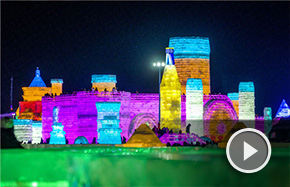
Ice and snow festival by Chinese, Mongolian and Russian organizers held in Inner Mongolia. Provided to China Daily |

|
The Ghengis Khan mausoleum in Ordos. Li Enzhong / For China Daily |

Herdsmen to settle down and preserve grasslands
Although its millions of people have lived a nomadic way of animal husbandry for thousands of years, Inner Mongolia should rely more on tourism to improve the quality of life and ecology in the years to come, said a senior tourism official.
"Tourism will be a new choice of the herdsmen as they are required to settle down to avoid over-grazing and protect the grassland environment," Wu Wenxue, a senior official in the National Tourism Administration, told a tourism development forum in Hohhot, capital city of the autonomous region.
The region's vast stretches of grassland - nearly 27 percent of the country's total - have important missions such as cultural continuity and ecological protection, he noted.
Drawing on the iconic rich natural resource to boost grassland tourism will increase the income of local people and also establish a model for other provinces and cities when carrying out similar projects.
In the birthplace of prairie culture with a core value of living peacefully and harmoniously with nature, the government in Inner Mongolia has been devoted to building the region into an "important ecologic barrier in North China" through the efforts of several generations.
An increasing number of visitors from both home and abroad are now attracted by the grasslands, forests, vast deserts and lakes, as well as cultural relics and distinctive folk customs.
Last year, the autonomous region received 1.59 million overseas tourists, an increase of 5 percent from 2011. It welcomed 58.87 million domestic travelers, up almost 14 percent.
Tourism revenue surpassed the 100 billion yuan mark for the first time as it hit 112.85 billion yuan, 26.86 percent more than the year previous. It accounted for 7 percent of the region's total industrial revenues.
Tourism will play "a significant role in helping Inner Mongolia transform its economic and social development mode", said Wu.
To fulfill such a function, the local government should make clear the direction of the tourism development, he noted.
The government's next move should focus on the development of demonstration zones as burgeoning tourism helps transform the economy. Grassland sightseeing should be combined with other scenery including deserts, forest and hot springs, he added.
Yet exploiting grassland resources should be done in moderation, he explained.
"Natural resources are vulnerable and the environment is also sensitive," he continued. "The local government should fully consider these factors and be aware of their bearing capacity using the help of scientific evaluation.
"The local government should stimulate the enthusiasm of nomadic people and make sure they can benefit from ecological tourism," he said.
Nomads, described as "roaming about for pasture" by ancient Greeks, can be found on the wild Eurasian steppes stretching from the Black Sea to China's Inner Mongolia.

In Inner Mongolia, there are some 49 ethnic groups living together harmoniously, most of them nomadic.
But they may no longer migrate on horseback with their tents, kitchen utensils and other necessities when the seasons change.
According to the State Council, nomads in Xinjiang, Tibet and Inner Mongolia are required to settle down at a fixed residence by 2015 to stop further deterioration of the grasslands.
These new settlers will be the main body of the tourism service system, local officials said.
They are encouraged to open restaurants and introduce some recreational activities to turn their residences into a kind of "agritainment park" to attract visitors.
Feasibility of using the ecological restoration funds from mining companies to develop grassland tourism will also be discussed by the local government.
Inner Mongolia requires companies to pay fees to compensate for damage to the environment caused by mining projects.
Local tourism authorities estimate that the autonomous region will receive 66 million domestic tourists and 1.65 million overseas travelers this year, increases of 12 percent and 3.7 percent from 2012.
Tourism revenue is projected to hit 137 billion yuan, a 21 percent rise from a year ago.
|
|
|