A head of steam
 |
|
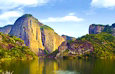
The ancient Grand Canal flows through some of the country's most fertile land and once served as an economic lifeline. Provided to China Daily |
The Grand Canal sweeps by the writer's hometown, suffusing him with childhood memories and a vista point to gaze into a country on the rise, observes Raymond Zhou.
Every time I visit my hometown, I go to the riverside and sit there for a few minutes. It has become a ritual of sorts. I walk to the riverbank in almost a trance, never treating it as something I have to do. It's less than one minute from where my parents live. In the old days, there was a dock for steamboats. That was the only means of transportation for those traveling out of town.
Lianshi, my hometown, sits halfway between Hangzhou to the south and Suzhou to the north. Boats that departed Hangzhou in the late afternoon would arrive here around midnight, and then onward to Suzhou, taking more than 12 hours for the whole journey - the equivalent of the red-eye flight.
When I was attending college in Hangzhou in the early 1980s, my grandmother would be alerted to my arrival by the sound of the horn in the quiet night. Five minutes later, I would be knocking on the door.
The Grand Canal does not flow through my hometown, or it did not before the town got much larger in size. It skirts the east side of the old town.
There is a sharp bend, which, coupled with the narrowness of the watercourse, posed a threat to boat people. So often did tragedies happen, with crew members falling into the river and getting drowned, that the bend became notorious as a curse.
If two boats happened to pass each other around the bend, they'd have to be extremely cautious not to have a collision or sudden swerve.
Now, this section of the river has been widened, with the sharp land protrusion cut, and the bridge not far away removed. Clearly it's much safer, but also less recognizable for someone like me who spent my childhood here.
A tributary of the Grand Canal does flow into town, dividing it into two parts - north and south.
Like all small towns in this area, there are several stone bridges, and rows of households flank the river. Between the first bridge and the second one lies the stretch of water where my buddies and I used to swim in summer. (To stop you from any idyllic visualization, I'll add that the river also served as the kitchen sink, the laundry basin and the source of drinking water, after being boiled of course. That was before we had tap water.)
I always envied my buddies who lived right along the river. They usually had the sitting room facing the street, the kitchen in the middle and the bedroom facing the water. As such, they could clean the wooden floor of the bedroom by pulling up water from the back window and pour it onto the floor, as riverbank pillars support this part of the house. The rooms would be so spotless we kids could roll around and get no stain at all.
Also, in those days, there were more activities on the river than on the street. Most boats were rowed by hand. When two boats passed each other, someone would shout "pull the paddle" (banshao) or "push the paddle" (tuishao) and they always miraculously avoided collision, not even a scratch against each other during my years of river watching.
Most boats were used for transporting goods. Occasionally, there was a boat that was essentially a floating abode. The whole family would live on it, with a stove and smoke billowing out during mealtime. I'd always notice a kid, smaller than I was, playing on the stern.

Of course, I envied them for the squeaky clean wooden floor and for the ability to go places. My parents would chide me, saying those boat people were among the poorest. "They don't have even electricity."
I never got to know a single boat family in person. We were townsfolk, guaranteed by the household registration system, and those people had to be peripatetic with no place to call home - except their boat.
There was one family though, a mother and a son around my age, living on the outskirts of the town. They lived in a mud hut, obviously unable to afford a brick house. And they didn't talk to anyone. They were refugees from the north, I heard, and they never fit in. I guess the boat people would be like them if they tried to settle down somewhere.
There used to be bountiful fish in the tributary. One day, someone driving an engine-powered boat speeded by with an electric rod. Soon, dead fish, large and small, popped to the surface.
"What a clever idea to catch fish," people said.
The river turned shallower and dirtier. By the year I got to high school, I could wade across to the other side. Maybe I was growing taller.
When I returned a decade ago, I was astonished to see the tributary banked up and weeds growing rampant in the section I used as my water playground. The houses flanking the river are now the most dilapidated in town, often rented out to out-of-towners scraping by with odd jobs.
To conjure up the sight of my childhood days on the river, I'd have to travel to the next town about half an hour downstream, Wuzhen, which has turned into a tourist hotspot, as it has restored the old landscape to its former beauty.
I never really swam in the Grand Canal - I mean the main waterway. And I've not seen anyone else doing it. Kids would play in the shallow water close to the bank. The water is said to be too swift.
There is a gas station by the river near my parents' home. I would sit there and watch barges go by. They carry stuff like coal and they are quiet, never announcing their presence by blowing horns, maybe because they've lost their luster as the in-vogue way of getting around.
"The highway network is so advanced now. Why do they keep using the river?" I would ask.
"It still makes economic sense," says my father, "and the same is not true of passenger traffic by water".
The barges are bigger and more frequent than those I can recall. They do not travel all the way from Hangzhou to Beijing. Well, the northernmost section of the Grand Canal is dried up like the tributary that runs through my town. But, as long as the canal still wraps around the town where I grew up, I'll have a place to anchor my vessel of recollections.
|
|
|