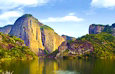
Yungang Grottoes
 |
|
Yungang Grottoes. [Photo by Thanin Yous/ For chinadaily.com.cn] |
Here was Buddha in different forms — Bodhisattvas, floating Apsaras (angels), worshipers with folded hands paying obeisance — all around the walls of the cave, inside and out, on the first floor and second, all intricately carved from stone. What distinguished them from other works of ancient Buddhist art in China, particularly statues such as those in Longmen, were the beautiful shades of green, blue and pastel red that could still be seen. Although Li Jing, our tour guide, had told us that the colors were redone during the Qing Dynasty (1644-1911), making them more recent than the statues, the effect was nevertheless mesmerizing. It was not difficult to imagine how magnificent the sculptures would have looked when they were initially finished with all those beautiful colors on the finely chiseled faces and robes. They still looked magnificent.
By any yardstick, the caves in Yungang are giants. Generally, they are two storied structures with quite a few having a central pillar to provide support, including Cave No 6. The carvings are immaculate and there are literally hundreds inside this single cave alone. From small carvings, only a few centimeters tall, to those reaching several meters high, they surround you from all sides. All through the cave, on both levels, are giant statues of Buddha, interspersed with all the other carvings in a perfect layout, the handiwork of a wonderful interior designer and architect. Anywhere you stand inside the cave you have a stunning 360-degree view of sheer bliss, which cannot fail to evoke that same divine sentiment inside your being.
The Yungang Grottoes, a UNESCO World Heritage site, were built over a period of about 60 years in the fifth century, starting around 460 AD, and are the earliest example of this kind of art and architecture in China. Spread over a distance of 1 kilometer in an east-west direction, there are 252 caves in all, containing a total of about 51,000 statues. The earliest of the caves are numbered from 16 to 20, each of which contains a giant statue of Buddha in different postures. Cave 20 has a 13.7-meter-tall Buddha and Cave 19 contains a 16.8-m-high Buddha. The tallest is in Cave 5, which has a 17-m-high Buddha, which eluded us, however, as it was closed to the public. Of the 252, about 45 caves have survived the vagaries of time and weathering, of which more than 30 are open, although that figure keeps changing.