New tax rule may cool ardor for cross-border purchases
 |
|
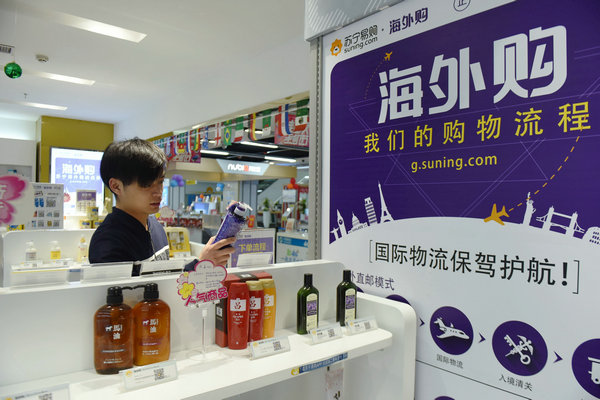
A customer visits a cross-border e-commerce shop in Hangzhou, Zhejiang province. [Photo by Long Wei/China Daily] |
Luo Tong has been shopping at international online retailers like Shopbop for years now. She usually receives her parcel within a week of her order and has rarely been taxed by customs.
But this time, she has waited three weeks and her parcel still hasn't arrived. Luo's friend, who has been ordering rice powder from Germany, was recently taxed for the first time, she says.
For a long time, Chinese consumers have turned to cross-border e-commerce sites, such as Tmall and JD for lower prices when buying overseas products.
But now the situation is changing as the Ministry of Finance has issued new regulations regarding taxes on cross-border purchases, effective since April 8.
According to the new regulations, personal orders from overseas will no longer be considered personal postal articles that enjoy a relatively low postal tax. Instead, they will now be classified as imported goods and will face tariffs like import VAT and consumption tax.
"I will wait to find out how much tax I have to pay this time and then decide if I should continue to order on these platforms," says Luo.
Cross-border e-commerce has grown rapidly over the last few years. According to the China E-Commerce Research Center, an affiliate of the Ministry of Commerce, the volume of cross-border e-commerce was 2 trillion yuan ($309 billion) in the first six months of last year, a 43 percent increase for the same period in 2014. The consumer trade segment made up 8 percent of the trade last year.
Cosmetics, maternity products, luxury goods, digital products, apparel and electronics were among the most popular items for Chinese consumers.
The new tariffs imposed on personal overseas purchases will reduce the price gap between traditional businesses and e-commerce sites, as well as between domestic and foreign products, Zhang Bin, a researcher on finance and taxation at the top think tank Chinese Academy of Social Sciences, told Xinhua News Agency.
The new regulation will apply to a list of 1,142 goods that include food and beverages, apparel, electronics and cosmetics.
The new tax rule varies depending on the type and price of the products. For food and cosmetics that are priced at less than 100 yuan, the tax has risen, while for clothes and cosmetics costing between 1,000 and 2,000 yuan the tax rates are lower, analysts say.
The new policy also poses challenges to online retailers. The new regulations will raise costs for the platforms and test their global supply chain, which will make it harder for some small players to survive, Tmall's global general manager Liu Peng says.