Condoleezza Rice's abrupt dismissal of a letter from Iran's president might
only strengthen hardline attitudes and mistrust of America, some Iranians warned
Tuesday.
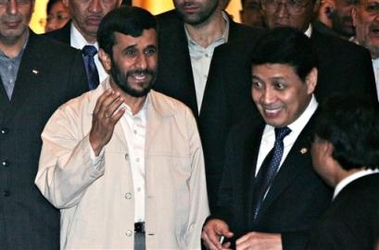
Iranian President
Mahmoud Ahmadinejad, left, waves as he is welcomed by Indonesia's Foreign
Minister Hassan Wirajuda, righ, on his arrival in Jakarta, Indonesia,
early Wednesday May 10, 2006. Ahmadinejad arrived in Indonesia early
Wednesday to discuss the international dispute over Tehran's nuclear
ambitions in the world's most populous Muslim nation.
[AP] |
As President Mahmoud Ahmadinejad began a high-profile visit to a key Muslim
country, Indonesia, a former top Iranian official said Rice's response will give
new justification to those who oppose ties with the U.S.
Iran's former ambassador to France, Sadeq Kharrazi, said the letter ¡ª the
first from an Iranian head of state to an American president in 27 years ¡ª
"could have been a turning point in relations." But he said Rice squandered the
opportunity with what he called a "hasty reaction."
"This gives a pretext to those in Iran who oppose re-establishment of ties
with America," he said.
Ahmadinejad's 18-page letter to President Bush touched only indirectly on the
hottest dispute between the two countries ¡ª Iran's nuclear program. Instead, it
focuses on a long list of grievances against the United States and seeks to
build on a shared faith in God to resolve them.
Rice told The Associated Press the letter "isn't addressing the issues that
we're dealing with in a concrete way."
Iranian political analyst Saeed Leilaz said Rice's quick brushoff would fuel
anti-American feelings in Iran.
"It could have been the beginning of a new process," he said. Rice's response
"strengthens the suspicion (inside Iran) that the U.S. is thinking of a military
option only and not a political solution" to the standoff over Iran's nuclear
program, he said.
As he boarded a plane for Indonesia on Tuesday, Ahmadinejad said his letter
contained "the demands of Iranian people and our nation."
"I discussed our views, beliefs and positions regarding international issues
as well as some ways out of problems humanity is suffering from," he told the
official Islamic Republic News Agency. "We will wait for reaction ... and then
we'll make decisions."
In Indonesia ¡ª the world's most populous Muslim nation, which has friendly
ties with the U.S. and European countries ¡ª Ahmadinejad was due to discuss the
nuclear issue with the country's president, then attend a summit of developing
nations.
"We want Iran to be more transparent in its program," Indonesian Foreign
Minister Hassan Wirajuda told reporters Tuesday.
The United States accuses Iran of seeking to develop nuclear weapons, a
charge Tehran denies, saying it aims only to generate energy.
Iranian Foreign Ministry spokesman Hamid Reza Asefi said the letter was not
intended to address the nuclear issue. "We have sufficient logic and legal
reasoning (to defend our program)," Asefi was quoted by the radio as saying.
"Our aim was to express our opinions about global problems and the way out of
these problems," he said.
Reaction to the letter was mixed in Iran and across the Mideast.
Iranian newspapers described the message as "an initiative in global
diplomacy" and "dialogue under the shadow of war."
But conservative lawmaker Hashmatollah Falahatpisheh lambasted Ahmadinejad
for failing to consult parliament before sending the letter to the country Iran
considers its greatest enemy.
"This message is the outcome of a series of taboo-breaking behaviors in
Iran's foreign policy. ... That the parliament is not aware of (the contents of
the) letter is questionable," Falahatpisheh told an open session of the
parliament broadcast live on state-run radio Tuesday.
Among Gulf nations, the letter fueled suspicions toward Iran.
The Saudi-owned daily Asharq Al-Awsat called the letter proof that "Iran is
not enriching uranium for peaceful purposes as it says, and is striving for
leadership and control of the region."
Such Iranian leadership would mean the Israeli-Palestinian peace process
"would be stalled, the Iraqi dream (of democracy) would be thwarted and we would
witness a new wave of armament," wrote Tariq Alhomayed, the paper's
editor-in-chief.
The Kuwaiti newspaper Arab Times ran an editorial in which editor-in-chief
Ahmed Al-Jarallah accused Ahmadinejad of acting "as if he owns the region."
Some of Iran's Arab neighbors have expressed fears over Iran's nuclear
program ¡ª particularly over pollution in case of an accident ¡ª as well as over
the standoff with the West, fearing possible Iranian retaliation against
American military bases in Kuwait, Qatar and Bahrain should the U.S. launch a
pre-emptive strike.
But an editorial in Lebanon's The Daily Star newspaper called the letter "a
cause for hope that a peaceful solution" to the nuclear standoff and called on
Washington to initiate direct talks with Tehran.
