Millions face hunger for climate change
(AP)Updated: 2007-04-11 07:08 MEXICO CITY - Rising global temperatures could melt Latin America's glaciers within 15 years, cause food shortages affecting 130 million people across Asia by 2050 and wipe out Africa's wheat crop, according to a U.N. report released Tuesday.
The report, written and reviewed by hundreds of scientists, outlined dramatic effects of climate change including rising sea levels, the disappearance of species and intensifying natural disasters. It said 30 percent of the world's coastlines could be lost by 2080.
Scientists with the Intergovernmental Panel on Climate Change outlined details of the report in news conferences around the world Tuesday, four days after they released a written summary of their findings. The report is the second of three being issued this year; the first dealt with the physical science of climate change and the third will deal with responses to it.
|
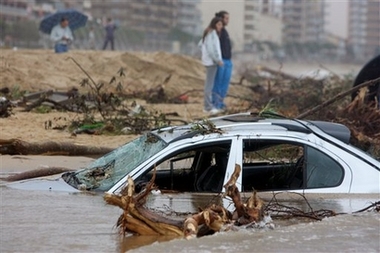
A couple look at a car that was washed away in flood waters in Sant Antoni de Calonge, Spain, in this Oct. 14, 2005 file photo. [AP] |
Polar ice caps will likely melt, opening a waterway at the North Pole and threatening to make the Panama Canal obsolete, IPCC member Edmundo de Alba said. Warmer waters will spawn bigger and more dangerous hurricanes that will threaten coastlines not traditionally affected by them.
Latin America's diverse ecosystems will struggle with intense droughts and flooding and as many as 70 million people in the region will be left without enough water, according to the report.
"What's clear is places suffering from drought are going to become drier, and places with a large amount of precipitation are going to see an increase in precipitation," de Alba said.
Many Latin American farmers will have to abandon traditional crops such as corn, rice, wheat and sugar as their soil becomes increasingly saline, and ranchers will have to find new ways to feed their livestock, scientists said.
They warned that governments are doing too little to prepare for the changes.
"We don't have medium- or long-term plans in Latin America. Governments look the other way," IPCC member Osvaldo Canziani said in Buenos Aires.
The report said Africa is most vulnerable to the effects of climate change. The fallout from a swiftly warming planet ¡ª extreme weather, flooding, outbreaks of disease ¡ª will only exacerbate troubles in the world's poorest continent, said Anthony Nyong, one of the lead authors.
Wheat, a staple in Africa, may disappear from the continent by the 2080s, the report said.
Africa has "the least responsibility for climate change and yet it is perversely the continent with the most at risk if greenhouse gases are not cut," said Achim Steiner, executive director of the U.N. Environment Program.
But Nyong said African governments cannot rely on outside aid to fix problems from climate change. "It is dangerous ... for African governments to continually and perpetually depend on aid for such things that have such a major impact on what we do," he told reporters in Nairobi, Kenya.
In Asia, nearly 100 million people will face the risk of floods from seas that are expected to rise between 0.04 inches to 0.12 inches annually, slightly higher than the global average.
The report suggests that a 3.6-degree increase in mean air temperature could decrease rain-fed rice yields by 5 percent to 12 percent in China. In Bangladesh, rice production may fall by just under 10 percent and wheat by a third by the year 2050.
The drops in yields combined with rising populations could put close to 50 million extra people at risk of hunger by 2020, 132 million by 2050 and 266 million by 2080, the report said.
"It is absolutely vital that international action is taken now to avoid dangerous climate change," Steiner said. "Otherwise the consequences for food and water security in Asia, as for many other parts of the world are too alarming to contemplate."
In Europe's Mediterranean region, climate change is expected to sap electric power generation, raise sea levels in coastal regions, reverse tourism trends and leave millions of people with water shortages, scientists said.
For Australians and New Zealanders, the warming temperatures will be felt mostly through more extreme weather.
"Heat waves and fires are virtually certain to increase in intensity and
frequency," said Kevin Hennessy, a lead author on the chapter for Australia and
New Zealand. "Floods, landslides, droughts and storm surges are very likely to
become more frequent and intense."
|
||
|
||
|
|