Americas
Bush to veto stem cell bill today
(AP)
Updated: 2007-06-20 23:23
 |
Large Medium Small |
WASHINGTON - President Bush has chosen to use his veto pen three times - twice on the stem cell issue where politics, ethics and science collide. Pushing back against the Democratic-led Congress, Bush plans to veto a bill Wednesday that would have eased restraints on federally funded embryonic stem cell research, White House spokesman Tony Fratto said.
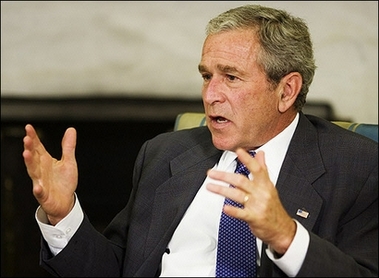 US President George W. Bush speaks during a meeting with Israeli Prime Minister Ehud Olmert in the Oval Office of the White House in Washington, DC.?[AP] |
At the same time, Bush will issue an executive order directing the Health and Human Services Department to promote research into cells that, like human embryonic stem cells, also hold the potential of regenerating into different types of cells that might be used to battle disease.
Democrats made the stem cell legislation Bush promised to veto a top priority when they took control of the House and Senate in January. They do not, however, have enough votes to override a veto.
"This is just one example of how the president puts ideology before science, politics before the needs of our families, just one more example of how out of touch with reality he and his party have become," Sen. Hillary Rodham Clinton, D-N.Y., told the Take Back America conference of liberal activists Wednesday.
In his veto threat, the president accused Democrats of recycling an old measure that he already vetoed and argued that the bill would mean American taxpayers would - for the first time - be compelled to support the deliberate destruction of human embryos.
"The president supports and encourages stem cell research, including using embryonic lines, as long as it does not involve creating, harming or destroying embryos," Fratto said. "That is an ethical line that should not be crossed."
Fratto said Bush would outline an initiative that could make federal funding available for research on additional "pluripotent" stem cells - ones that can give rise to any kind of cell in the body except those required to develop a fetus.
The National Institutes of Health says these stem cells offer the prospect of having a renewable source of replacement cells and tissues to treat Parkinson's and Alzheimer's diseases, spinal cord injury, stroke, burns, heart disease, diabetes, osteoarthritis and rheumatoid arthritis and other conditions.
Scientists were first able to conduct research with embryonic stem cells in 1998, the NIH says. There were no federal funds for the work until Bush announced on Aug. 9, 2001, that his administration would make the funds available for lines of cells that already were in existence.
Currently, states and private organizations are permitted to fund embryonic stem cell research, but federal support is limited to cells that existed as of Aug. 9, 2001. The latest bill is aimed at lifting that restriction.
The science aside, the issue has weighty political and ethical implications.
Public opinion polls show strong support for the research, and it could return as an issue in the 2008 elections.
Opponents of the latest stem cell measure insisted that the use of embryonic stem cells was the wrong approach on moral grounds - and possibly not even the most promising one scientifically. These opponents, who applaud Bush's veto, cite breakthroughs involving medical research conducted with adult stem cells, umbilical cord blood and amniotic fluid, none of which involve the destruction of a human embryo.
This will be the third veto of Bush's presidency. His first occurred last year when he rejected legislation to allow funding of additional lines of embryonic stem cells - a measure that passed over the objections of Republicans then in control. The second legislation he vetoed would have set timetables for US troop withdrawals from Iraq.
Senate Majority Leader Harry Reid appealed to Bush on Tuesday to put his veto pen back in his pocket. Reid said the measure acknowledges the ethical issues at stake and offers even stronger research guidelines than exist under the president's current policy.
House Speaker Nancy Pelosi used Bush's veto threat as a reason to send out an e-mail letter soliciting contributions to the Democratic Congressional Campaign Committee to help elect more Democrats.
"By vetoing a bill that expands stem cell research, the president will say 'no' to the more than 70 percent of Americans who support it, 'no' to our Democratic Congress' fight for progress, and 'no' to saving lives and to potential cures for diseases such as diabetes and Parkinson's," Pelosi wrote. "He will say 'no' to hope."
In light of the veto, Sen. Norm Coleman, R-Minn., who planned to be at the White House event, sought support for a stem cell bill he is sponsoring. It has passed the Senate but has not yet been taken up by the House.
"My stem cell bill, which passed the Senate with broad bipartisan support, offers a clear alternative for our colleagues in the House to significantly expand federally funded stem cell research, while ensuring no taxpayer dollars are used for the destruction of human embryos," Coleman said.
Coleman urged Democrats who favored the bill Bush was to veto to get behind his legislation.
"Those who support the stem cell research bill ... are at a definitive crossroads," he said. "Do they seek to advance lifesaving research for millions of Americans suffering from serious disease or do they, in fact, prefer to keep stem cell research at a political stalemate?"
| 分享按鈕 |