WORLD> Asia-Pacific

|
WORLD> Asia-Pacific
|
|
Mumbai attacks show up India's technology shortcomings
(Agencies)
Updated: 2008-12-11 17:34 MUMBAI -- Indian police are grappling with global positioning systems (GPS), satellite phones and Google Earth images on the trail of the Mumbai attackers and finding themselves hobbled by technological inadequacy.
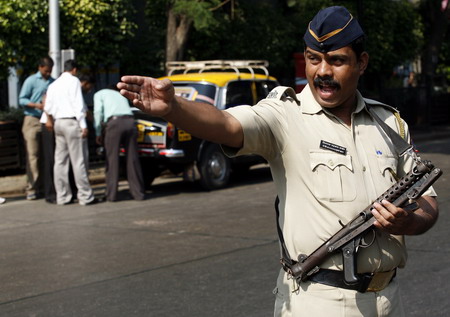
So far, police have found four GPS handsets, one satellite phone, nine mobile phones and computer discs with high-resolution images and maps of the 10 sites that were attacked. The use of the Internet to make calls has also hampered the investigation. "The use of technology has made it very difficult for us," Param Bir Singh, a top officer in Mumbai's anti-terrorism team, told Reuters. "For the people we are dealing with, money is not a problem, and even the ones that are not very educated are trained in all manner of devices and know how to make interception difficult." The lone surviving gunman of the Mumbai attack reportedly told interrogators in Mumbai the 10 gunmen, who led the three-day siege that killed 179 people, were shown videos and Google Earth images of the targets during their training in camps in Pakistan. "They probably used the GPS for navigation and the satellite phone when they were on the sea, and then used the mobile phones to stay in touch with their handlers during the operations," Rakesh Maria, lead investigator of the police, has said. Ratan Shrivastava, a defence expert at consultancy Frost & Sullivan and a former army officer, said "hostile groups" that have attacked India have always used very sophisticated technology and were typically very well-trained in the use of technology. "While the Indian armed forces are well-equipped and our intelligence services have the capability to take on these technologies, there is very little coordination between them and the police, which is ill-equipped," he said. He said a large part of the intelligence gathered these days is from monitoring the airwaves and intercepting conversations and e-mails but India lacked the resources and coordination to analyse and respond to the intelligence. Mumbai police acknowledge the difficulties and the militants' apparent ease with sophisticated technology. Singh said militants used VoIP (Voice over Internet Protocol) and satellite phones, making it harder to intercept conversations. They also used multiple phone cards for mobile phones and routed e-mails through servers in different locations, which make it harder to trace. There were also some reports they used BlackBerry devices to scan the news after the siege began, but the police have denied finding BlackBerry devices on the gunmen. Security analyst Ajai Sahni was dismissive of Indian police forces' standard-issue weapons. "Our police are still running around with lathis (sticks) and World War-II era rifles. We are simply not equipped to respond to a sophisticated system of this kind." Security Hazard In Mumbai, a public interest litigation filed by a city lawyer has sought a ban on Google Earth for providing easy access to "sensitive" defence and civilian establishments, which poses a security hazard to the country, according to local newspapers. Earlier this year, Indian security agencies expressed fears the BlackBerry e-mail device could be used by militants to send e-mails that could not be traced or intercepted. The telecoms ministry in July cleared the service. Google Earth is putting checks in place to alert governments when sensitive images are downloaded, but militants around the world have used off-the-shelf technologies to stay ahead of bigger, better-funded agencies, security analyst Sahni said. So banning these services is no solution to tackling terror. "If you ban something, people will still find ways to get around it," he said, pointing to India's earlier attempts to curb mobile phone use in the troubled state of Jammu and Kashmir and the restive northeast. "And where will you draw the line? Will we ban mobile phones all together, and ban automobiles and airplanes because they are also be used by attackers?" |