WORLD> Global General

|
WORLD> Global General
|
|
Related
New NASA report details final minutes of Columbia
(Agencies)
Updated: 2008-12-31 09:19 WASHINGTON – When the first of many loud alarms sounded on the space shuttle Columbia, the seven astronauts had about a minute to live, though they didn't know it. The pilot, William McCool, pushed several buttons trying to right the ship as it tumbled out of control. He didn't know it was futile. Most of the crew were following NASA procedures, spending more time preparing the shuttle than themselves for the return to Earth.
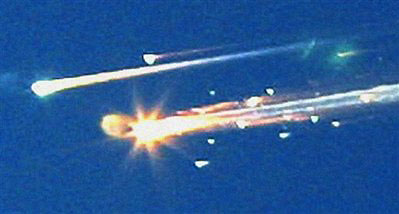
Some weren't wearing their bulky protective gloves and still had their helmet visors open. Some weren't fully strapped in. One was barely seated. In seconds, the darkened module holding the crew lost pressure. The astronauts blacked out. If the loss of pressure didn't kill them immediately, they would be dead from violent gyrations that knocked them about the ship. In short, Columbia's astronauts were quickly doomed. A new NASA report released Tuesday details the chaotic final minutes of Columbia, which disintegrated over Texas on Feb. 1, 2003. The point of the 400-page analysis is to figure out how to make NASA's next spaceship more survivable. The report targeted problems with the spacesuits, restraints and helmets of the Columbia crew. Many of the details about the astronauts' deaths have been known — they died either from lack of oxygen during pressure loss or from hitting something as the spacecraft tumbled and broke up. However, the new report paints a more detailed picture of the final moments of the Columbia crew than the broader investigation into the accident five years ago. Astronaut Pam Melroy, deputy study chief, said the analysis showed the astronauts were at their problem-solving best trying to recover Columbia, which was starting to crack up as it re-entered Earth's atmosphere with a hole in its left wing, damage that had occurred at liftoff. "There was no way for them to know that it was going to be impossible." The crew had lost control of the motion and direction of the spacecraft. It was pitching end-over-end, the cabin lights were out, and parts of the shuttle behind the crew compartment — including its wings — were falling off. "It was a very disorienting motion going on," NASA deputy associate administrator Wayne Hale said in a telephone conference call. "There were a number of alarms going off simultaneously. The crew was trying very hard to regain control. We're talking about a brief time in a crisis situation." The NASA study team is recommending 30 changes based on Columbia, many of them aimed at the spacesuits, helmets and seatbelts for both the shuttle and the next space capsule NASA is building. Since the accident, NASA has quietly made astronauts put more priority on getting their protective suits on, Melroy said. NASA's suits don't automatically pressurize, "a basic problem of suit design and it is one we intend to fix with future spacecraft," Hale said. Had the astronauts had time to get their gear on and get their suits pressurized, they might have lived longer and been able to take more actions. But they still wouldn't have survived, the report notes. The report lists events that were each potentially lethal to the crew: Loss of cabin pressure just before or as the cabin broke up; crew members, unconscious or already dead, crashing into objects in the module; exposure to a near vacuum at 100,000 feet; and crashing to the ground. Killed in the Columbia disaster along with pilot McCool, were commander Rick Husband, Michael Anderson, David Brown, Kalpana Chawla, Laurel Clark, and Israel's first astronaut, Ilan Ramon. Columbia was the second space shuttle NASA has lost. The hole in its wing was caused by a piece of foam insulation that broke off the fuel tank and slammed into it at launch. The shuttle Challenger blew up shortly after liftoff on 1986, also claiming seven lives. Investigators in both accidents pointed to a NASA culture of ignoring problems that later turned fatal. Dr. Jonathan Clark, a former NASA flight surgeon and husband of Laurel Clark, praised NASA's leadership for the report "even though it says, in some ways, you guys didn't do a great job." "I guess the thing I'm surprised about, if anything, is that (the report) actually got out," said Clark, who was a member of the team that wrote it. "There were so many forces" that didn't want to produce the report because it would again put the astronauts' families in the media spotlight. Some of the recommendations already are being applied to the next-generation spaceship being designed to take astronauts to the moon and Mars, said Clark, who now works for the National Space Biomedical Research Institute at Baylor College of Medicine in Houston. Kirstie McCool Chadwick, sister of William McCool, said a copy of the report arrived at her Florida home Tuesday morning but she had not read it.
NASA held the report till after Christmas at the request of the families. John Logsdon, who was a member of the original Columbia accident investigation board, questioned the need for the report, saying, "Those people are dead. Knowing in specifics how they died should be a private matter." But for friends of the astronauts working on the investigation, confirming that the crew didn't suffer much "is a very small blessing," Melroy said. |