WORLD> America

|
WORLD> America
|
|
1st deep sea observatory looks at climate change
(Agencies)
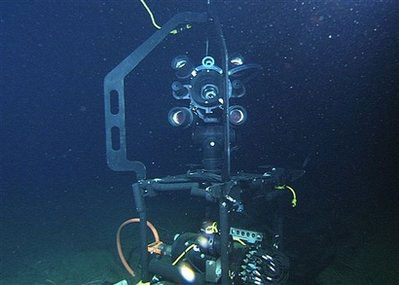
Updated: 2009-02-05 14:53 ABOARD RESEARCH VESSEL POINT LOBOS, Off the California Coast— A crane on a ship deck hoisted a 502-pound video camera and plopped it into the ocean for a 3,000-foot descent to the world of neon-glowing jellyfish, bug-eyed red rock cod and other still unknown slithery critters.
The so-called Eye-in-the-Sea camera would be added to the first observatory operating in deep sea water and become part of a new kind of scientific exploration to assess the impacts of climate change on marine life. "Bye bye," said marine scientist Edith Widder, who supervised the deployment last month as the bulking Web camera splashed into the water and disappeared into blackness. "Hope it works." The camera is one of many instruments powered by the Monterey Accelerated Research Station or MARS, an underwater observatory that began operating in November off the California coast. The observatory, which looks like a giant metal pyramid at the bottom of the ocean, is connected to shore by 32 miles of cable and serves as a gigantic electrical outlet for equipment such as the camera. Other instruments measure currents and seismic activity, while another part studies how higher acidity would affect marine life. Scientists say the observatory's success will spawn others around the world, at a time when scientists warn that coral reefs and other sea life are being harmed by rising ocean acidity from absorption of greenhouse gas pollution. Previous deep sea exploration relied on battery-powered instruments that had to be fished from the water. But the observatory permits real time information to stream to shore, giving researchers a faster, better understanding of how greenhouse gas pollution is changing the ocean. The $600,000 Web camera offers scientists, students and others the opportunity to watch life at 500 fathoms. The camera captures images illuminated with "far-red" lights, a spectrum of luminescence invisible to undersea animals. "The revolution in oceanography is to replace expeditionary science with a permanent presence in the ocean in the deep sea," said Widder, a senior scientist at the Ocean Research and Conservation Association, a nonprofit that develops high-tech equipment for ocean study. Back on the research vessel 22-miles from shore, scientists in a control room used joysticks and high-definition video relayed from cameras on a submersible robot to grab the camera's bright-orange power cord. After about four painstaking hours of maneuvering the submersible, the researches used its robotic arm to plug the camera into the observatory. Within minutes, a phone in the control room rang — the blurred, black and white video was streaming from the camera to researchers onshore. Also, researchers were able to twist and turn the camera remotely, and turn on the camera's electronic bait: a circular pattern of blue, neon-like lights that mimic a luminescent jellyfish that lives at these depths. Researchers were able to immediately make out a few lazy fish lying in the sand. Their expectation are high for the 24-hour camera: A previous, battery-powered version recorded images of a large, white squid that could be new to science, as well as a deep sea shark. It took six years of planning to make the observatory a reality. It was scheduled to go live in February 2008, but after crews sunk it into its new deep water home, a leak was discovered in its main power supply, forcing it to be shut off and hauled back ashore. The $13.5 million station is being watched closely by scientists all over the world, and is a test for the National Science Foundation's proposed $400 million rollout of a network of similar observatories off the US coast. "With rising sea levels as a result of ocean warming and ice caps melting, we need better observations recorded regularly and openly to better quantify what's happening to the oceans and the planet," said John Orcutt, a professor of geophysics at University of California, San Diego's Scripps Institution of Oceanography. The ocean is absorbing most of the carbon dioxide from burning fossil fuels, which has resulted in increased acidity, according to published studies. Greenhouse gas pollution is also blamed for warming the ocean, a trend that, if allowed to continue, could kill a wide array of marine life, according to climate change studies. In Canada, scientists plan to launch five similar observatories this summer, some even deeper, said Mairi Best, associate director of science for the Northeast Pacific Time-Series Undersea Networked Experiments. |