WORLD> Photo

|
WORLD> Photo
|
|
NASA's global warming satellite fails at launch
(Xinhua)
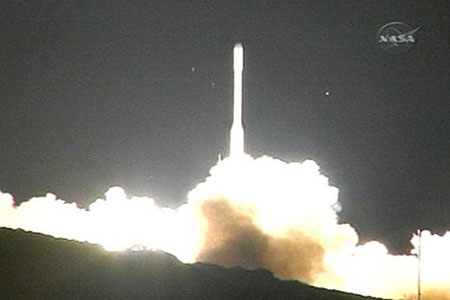
Updated: 2009-02-25 16:15 WASHINGTON - A rocket carrying a NASA satellite designed to study global warming from space crashed in the ocean near Antarctica after a failed launch early Tuesday.
The Taurus XL rocket carrying the $278 million Orbiting Carbon Observatory (OCO) blasted off at 4:55 a.m EST (9:55 a.m. GMT) on Tuesday from California's Vandenberg Air Force Base. However, the fairing on the rocket, a cover that protected the satellite as it flew through the atmosphere, failed to separate from the rocket as expected.
"Our whole team at a very personal level is disappointed in the events of this morning," he said. "It's very hard." Brunschwyler said the first sign of trouble occurred about three minutes after liftoff, when the rocket's telemetry showed no sign it had shed its clamshell-like fairing. Once the fairing separates, launch controllers would have seen the satellite and its upper stage accelerate faster since the rocket would have shed the excess weight. But that speed boost never occurred. "As a direct result of carrying that extra weight, we could not make orbit," Brunschwyler said, adding that the failure ultimately sent the OCO crashing into the ocean near Antarctica. A Mishap Investigation Board would be convened immediately to determine the cause of the launch failure, a press release issued by NASA said. The investigation will be key for NASA's Glory satellite, an environment-monitoring spacecraft also designed to aid climate change studies and slated to launch on a Taurus rocket in October. "Our goal will be to find a root cause of the problem," said NASA launch director Chuck Dovale. "We won't fly Glory until we have that data known to us." Tuesday's failure comes a month after Japan successfully launched the world's first satellite to monitor global warming conditions. The OCO spacecraft was NASA's first satellite built exclusively to map carbon dioxide levels on Earth and understand how humanity's contribution of the greenhouse gas was affecting global climate change. The satellite carried a single three-channel spectrometer to make its detailed measurements. Before the launch, NASA said that data from the observatory would reduce uncertainties in forecasts of how much carbon dioxideis in the atmosphere and improve the accuracy of global climate change predictions. Carbon dioxide is the leading greenhouse gas and its buildup helps trap heat from the sun, causing potentially dangerous warming of the planet. Since its 1994 debut, the Taurus rocket has flown six successful missions out of eight launches to orbit 12 satellites. The last Taurus launch reached space successfully in 2004. The one failure before Tuesday occurred in September 2001.
|
||||||