WORLD> America

|
WORLD> America
|
|
Recession on track to be longest in postwar period
(Agencies)
Updated: 2009-03-09 08:09 WASHINGTON – Factory jobs disappeared. Inflation soared. Unemployment climbed to alarming levels. The hungry lined up at soup kitchens.
It wasn't the Great Depression. It was the 1981-82 recession, widely considered America's worst since the depression. That painful time during Ronald Reagan's presidency is a grim marker of how bad things can get. Yet the current recession could slice deeper into the US economy.
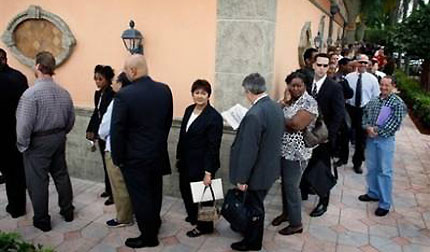
Unemployment hasn't reached 1982 levels and the gross domestic product hasn't fallen quite as far. But the hurt from this recession is spread more widely and uncertainty about the country's economic health is worse today than it was in 1982. Back then, if someone asked if the nation was about to experience something as bad as the Great Depression, the answer was, "Quite clearly, 'No,'" said Murray Weidenbaum, chairman of the Council of Economic Advisers in the Reagan White House. "You don't have that certainty today," he said. "It's not only that the downturn is sharp and widespread, but a lot of people worry that it's going to be a long-lasting, substantial downturn." For months, headlines have compared this recession with the one that began in July 1981 and ended in November 1982. -- In January, reports showed 207,000 manufacturing jobs vanished in the largest one-month drop since October 1982. -- Major automakers' US sales extended their deep slump in February, putting the industry on track for its worst sales month in more than 27 years. -- Struggling homebuilders have just completed the worst year for new home sales since 1982. -- There are 12.5 million people out of work today, topping the number of jobless in 1982. "I think most people think it is worse than 1982," said John Steele Gordon, a financial historian. "I don't think many people think it will be 1932 again. Let us pray. But it's probably going to be the worst postwar recession, certainly." The 1982 downturn was driven primarily by the desire to rid the economy of inflation. To battle a decade-long bout of high inflation, then-Federal Reserve Chairman Paul Volcker, now an economic adviser to President Barack Obama, pushed interest rates up to levels not seen since the Civil War. The approach tamed inflation, but not without suffering. Hardest hit was the industrial Midwest; the Pacific Northwest, where the logging industry lagged from construction declines; and some states in the South, where the recession hit late. Frustrated workers fled to the Sunbelt to find work. In Michigan, which led the nation in jobless workers, newspapers offered idled auto workers free "job wanted" ads in the classified section. Mortgages carried double-digit interest rates. When the 1982 recession ended, the national jobless rate had hit 10.8 percent. Just like today, that recession led to political finger-pointing. When the government reported a 10.1 percent jobless rate for September 1982, organized labor rallied across the street from the White House. A few protesters chained themselves to an entrance at the Labor Department. The US Chamber of Commerce called it a national tragedy and blamed Democrats. Democrats called it a national tragedy and blamed Reagan. Even months after the recession officially ended, Reagan was greeted in Pittsburgh by signs that said: "We want jobs, Mr. Hoover" and "Reagan says his economic program is working -- are you?" President Herbert Hoover's term is forever linked in history with the Great Depression. Those not as badly hurt have fuzzy memories of the 1981-82 recession. Not Jim O'Connor of Pekin, Ill., who was president of United Auto Workers Local 974 when Caterpillar Tractor Co. was laying off workers in Peoria in the 1980s. Maybe time has soothed the sting O'Connor felt, but he contends the economic problems facing workers today are worse than during the recession he survived nearly three decades ago. "The days of walking out of one factory and walking into another one down the street are over," O'Connor said. He retired from Caterpillar in 2001 but thinks he might find part-time job to help pay his health insurance. "When I hired in at Caterpillar in 1968, we had numerous factories here. Almost all of that has left the country or moved South. The unions don't have any leverage anymore at the bargaining table. So these young people (today) aren't only out of work, you know. They weren't making a living wage when they lost their job," he said. Like Reagan did then, Obama is dishing up hope. Trouble is, people can't visualize any reward they might get from making it through this recession, said William Niskanen, an economic adviser to Reagan. There's little hope of any gain from the pain. Falling housing and stock prices have undermined household wealth. People are worried about losing their jobs, their homes and their retirement savings all at a time when health care is weighing down income. "In the 1980s, it was clear to people that the inflation rate was going to come way down and it did," Niskanen said. "There was a sense that we were going through a tough time for a while as a price of getting inflation down and that things would come back up. Today, they can't see any gain from what's going on." Consumer confidence is in free fall. Banks are in peril. The overall US economy, as measured by the GDP, shrank at a 6.2 percent annual rate in final three months of last year, the worst drop since the first quarter of 1982. The unemployment rate, at 8.1 percent in February, hasn't reached the 10.8 percent reported in November 1982, but the recession is not over. It's not only blue-collar workers who are feeling the greatest anguish. Americans who are trapped in houses worth less than their mortgages are suffering. So, too, are people whose personal wealth is tied to the stock market. Personal wealth is dwindling in the US, and the effects of the financial meltdown have been felt around the world. "This recession is broader, deeper and more complicated than virtually anything we have ever seen," Wachovia Corp. economist Mark Vitner said. "The whole evolution of the credit markets resulted in all sorts of complex financial instruments that are difficult to unwind. It's like trying to unscramble scrambled eggs. It just can't be done that easily. I don't know if it can be done at all." He said he sees fear in the eyes of his clients. "I've had people come up and hug me after a presentation, which is unusual," he said. "I haven't told them anything about how it's going to be better, but they just feel better having a better understanding of what's happening." |
|||||||||