Asia-Pacific
Job creation near but likely to be painfully slow
(Agencies)
Updated: 2009-12-04 16:56
|
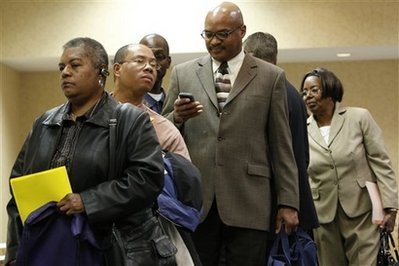 Job seekers wait in line to speak to potential employers at a job fair in Philadelphia on Dec 1, 2009.[Agencies]  |
WASHINGTON: The economy is getting closer to generating jobs for the first time in two years, but it probably won't be enough to stop the unemployment rate from rising.
Analysts expect the Labor Department will report Friday that employers cut a net total of 130,000 jobs in November, according to a survey by Thomson Reuters. That's an improvement from 190,000 the previous month.
The department is also expected to say the unemployment rate will remain 10.2 percent, the same as in October, a 26-year high.
Two economic reports Thursday gave some economists hope that employers will gear up hiring early next year and that the economy will start adding jobs in the first quarter. But the unemployment rate may still rise well into 2010.
That's because 15.7 million unemployed Americans will also have to compete against a huge number of "underemployed" workers for any new jobs that are created. The government estimates there are another 11.7 million people working fewer hours than they'd like or that have given up looking for work.
It could take years for the economy to generate enough jobs for all those people and bring down the unemployment rate, analysts said.
Persistent joblessness is causing political headaches for President Barack Obama, who held a "job summit" Thursday at the White House.
|
||||


Companies are firing fewer employees. The number of newly laid-off workers claiming unemployment benefits fell for the fifth straight week, the Labor Department said Thursday, to the lowest level in over a year.
First-time claims for unemployment insurance dropped by 5,000 to 457,000, much better than the increase analysts had anticipated.
The drop indicates that layoffs are slowing. If claims drop to about 425,000 for several weeks, that could be a sign the economy will see net job gains. That level could be reached as soon as February, several economists said.
"We're not that far away from seeing the labor market begin to stabilize and create jobs," said Bruce Kasman, chief economist at JPMorgan Chase & Co.
That could take place as soon as the first quarter of next year, Kasman said. Employers have so far cut jobs for 22 straight months.
The Labor Department also said that productivity, the amount of output per hour worked, jumped at an 8.1 percent rate in the July-September quarter, the largest increase in six years.
That means companies are squeezing more output from their current work forces, and helps explain why so few employers are hiring, even as the economy slowly recovers. The nation's gross domestic product grew 2.8 percent in the third quarter, snapping four straight quarters of decline.
But businesses can only push their current workers so much and will eventually have to hire more people, economists said.
Recent productivity gains are "absolutely remarkable and equally unsustainable," said Carl Riccadonna, an economist at Deutsche Bank. Riccadonna also expects hiring to turn positive in the first quarter.
But the unemployment rate is likely to keep rising even if there are modest job gains. Some economists project it could peak near 11 percent next year.
That's partly because the number of jobseekers is so high, even compared to previous recessions.
For example, the number of part-time workers who would like full-time work has more than doubled during the recession, to about 9.3 million.
There are another 2.4 million people who would like a job but aren't looking for work, either because they have given up on finding a job or have returned to school. Those people are no longer counted among the unemployed.
When they are combined with the unemployed, the total "underemployment rate" was 17.5 percent last month, the highest since the government began tracking it in 1994.
David Rosenberg, chief economist for Canadian wealth management firm Gluskin Sheff, said the 7 point difference between the jobless rate and underemployment rate is almost double the usual gap. That's an indication of how many more people are likely to be looking for work in coming months.
The unemployment rate is likely to climb as high as 12 percent, Rosenberg said. Those economists who expect it to peak near its current levels are "borderline delusional," he said.
Meanwhile, on Thursday the Institute for Supply Management's service sector index dropped to 48.7 from 50.6 in October. Analysts polled by Thomson Reuters had expected a level of 51.1. Any reading below 50 signals contraction. The service sector had begun growing in September for the first time in 13 months.
The ISM measure tracks more than 80 percent of the country's economic activity, including such diverse industries as health care, retail, financial services and transportation.
The trade group said employment shrank for the 22nd time in the last 23 months, albeit at a slightly slower pace. Business activity shrank again after growing for the past three months and backlogs contracted. But new orders, a sign of future growth, continued expanding and prices rose.
"Most indicators suggest ... the economy is emerging from the recession," Federal Reserve Chairman Ben Bernanke told Congress Thursday. "Yet our task is far from complete. Far too many Americans are without jobs, and unemployment could remain high for some time even if, as we anticipate, moderate economic growth continues."