Asia-Pacific
Treaty to cut US-Russia nukes, signing in 2 weeks
(Agencies)
Updated: 2010-03-25 20:19
 |
Large Medium Small |
|
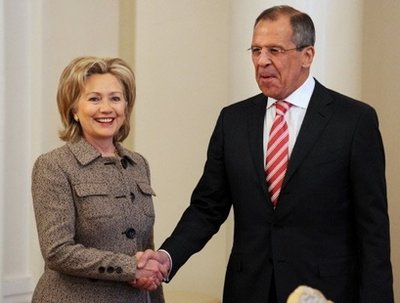 US Secretary of State Hillary Clinton (L) shakes hands with Russian Foreign Minister Sergei Lavrov (R) in Moscow on Thursday. Clinton visited Russia in a bid to accelerate progress towards a new accord between the Cold War foes to drastically reduce their nuclear arsenals. [Agencies] |
WASHINGTON - The US and Russia reached a breakthrough agreement Wednesday for a historic treaty to reduce the nuclear arsenals of the former Cold War rivals, the most significant pact in a generation and an important milestone in the decades-long quest to lower the risk of global nuclear war.
After long and trying negotiations, US President Barack Obama and Russian President Dmitry Medvedev are to sign the treaty in two weeks in Prague, once final technical details are worked out, officials in Washington and Moscow said. The accord is expected to cut the number of long-range nuclear weapons held by each side to about 1,500, and it raises hopes for further disarmament in the years ahead.


Obama and Medvedev are expected to seal the deal when they talk by telephone this week, setting the stage for a White House campaign to win Senate ratification. The treaty also must win approval by the Russian Duma, and the two legislative processes are likely to take months.
Robert S. Norris, a longtime analyst of US and Russian nuclear arsenals, said Senate ratification would not be easy.
"Hard negotiations with the Russians will now be followed by hard negotiations with Republican senators to achieve ratification," Norris said.
Though the State Department said the two countries were still working out unspecified final technical details, spokesman Mark Toner said there had been discussions with the Czech government about holding a signing ceremony in Prague?-- where Obama last April declared his vision of a nuclear-free world.
In fact, Czech officials announced that Prague would host the signing.
They did not give a date, but Russian and US officials said it was expected to be April 8.
The new agreement to reduce long-range nuclear weapons would replace the 1991 Strategic Arms Reduction Treaty, which expired in December. An important feature of the new deal is that it includes a legal mechanism for verifying that each side complies?-- an element that was absent from a 2002 deal, known as the Moscow Treaty, that accelerated the weapons reductions laid out in the 1991 treaty.
The Moscow Treaty set limits on both sides' strategic nuclear warheads at between 1,700 and 2,200. The new deal, whose provisions have not been made public, is expected to lower that to about 1,500. It also would reduce the permissible number of strategic launchers?-- the missiles and bombs that deliver warheads to their targets.
Obama spent an hour Wednesday in the White House briefing Democratic Sen. John Kerry, chairman of the Senate Foreign Relations Committee, and Sen. Richard Lugar, the committee's ranking Republican. Both would play major roles in ratification of the emerging treaty.
Kerry said he and Lugar would hold hearings to examine details.
"A well-designed treaty will send an important message to the rest of the world that America is prepared to lead efforts with key stakeholders to reduce the threat of nuclear weapons," Kerry said.
Maria Lipman, an expert with the Moscow Carnegie Center think tank, said this week the new treaty could not only reduce the size of both country's nuclear arsenals but also change the psychology of the US-Russia relationship, which has been strained for at least the past six years.
"Gradually the attitude may change to where America is not seen from Russia as a force to be treated with suspicion," she said.


