Asia-Pacific
Chile miners must move tons of rocks in own rescue
(Agencies)
Updated: 2010-08-30 10:07
 |
Large Medium Small |
SAN JOSE MINE, Chile - The 33 trapped Chilean miners who have astonished the world with their discipline a half mile underground will have to aid their own escape?- clearing thousands of tons of rock that will fall as the rescue hole is drilled, the engineer in charge of drilling said Sunday.
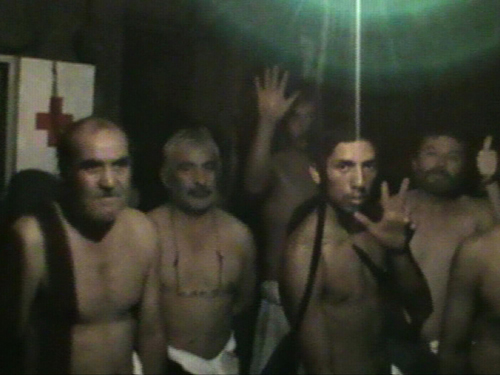 Trapped miners are seen underground in a copper and gold mine at Copiapo, some 725 km (450 miles) north of Santiago, in this frame grab taken August 29, 2010. [Agencies]? |
After drilling three small bore holes in recent weeks to create lines of communication with the miners and deliver basic food and medicine, Chile's state-owned Codelco mining company will begin boring a rescue hole Monday afternoon that will be wide enough to pull the men up through 2,300 feet (700 meters) of earth.
| ||||


Failure to keep the bottom clear of debris could quickly plug the hole, delaying a rescue that officials say could take three to four months.
"The miners are going to have to take out all that material as it falls," Andres Sougarret, Codelco's head engineer on the operation, told The Associated Press in a phone interview.
In all, the trapped miners will have to clear between 3,000 and 4,000 tons of rock, work that will require crews of about a half-dozen men working in shifts 24 hours a day.
The men have basic clearing equipment, such as wheel barrows and industrial-sized battery-powered sweepers, Sougarret said. The hole will likely end up several hundred yards (meters) from their living area in the mine's shelter, giving the men room to maneuver and store the rocks, he added.
Sougarret declined to estimate how long the work would take, saying it would depend on how each step went.
Once drilling begins, the team will have to decide whether to fit the wider hole with metal casing, often used to seal a hole and prevent collapses in the walls.
"We may not have to use it in this case because the rock is really high quality, really strong," he said.
On Sunday, Mining Minister Laurence Golborne, reiterated the government's estimate of three to four months to rescue the men, rejecting local reports citing engineers who said it could be done in much less time.
Golborne, wearing a hard hat and standing in front of the bore hole where rescuers first made contact with the men, said that experts had analyzed 10 different methods to get the men out, will continue to study other options, but that "nothing has yet been found that will be quicker."
While it's unclear if the government is simply trying to under-promise and then over-deliver, there is widespread agreement that the major drilling operation is unlikely to endanger the miners.
"If the area where the miners are didn't get crushed in the initial collapse, drilling this new hole isn't going to do that," Walter Veliz Araya, the geologist who was in charge of drilling the three bore holes, told the AP.
Mario Medina Mejia, a Chilean mining engineer not involved in the operation, agrees.
"The question isn't whether they can safely get to the miners," Mejia said. "It's how long can the miners wait for them to arrive?"
Normally, after completing a pilot hole, the opening is enlarged by drilling from the bottom up. The drill, hanging at the bottom of the pilot hole, is reached through existing shafts in a mine and then fitted with the machine cutters, which then blast through rock as they are raised.
In this case, however, there is no way to get those large cutters to the bottom of the mine; if there was a hole large enough to reach it, the men would already have been rescued.
Araya said that knowledge gained drilling the initial holes, which are between 20 and 100 yards (meters) from the shelter, would give the team digging the rescue hole a head start. For example, while penetrating rock, the circular motion of the bits causes the drill to veer right. In this case, the especially hard rock exaggerates that, making constant correction necessary, he said.
From the moment the mine collapsed August 5, the trapped men have had a central role in keeping themselves alive?- getting to the safety chamber, rationing food and keeping order with extraordinary discipline.
Still, many questions remain. What physical and mental condition will the men be in when they are called on to help save themselves?
"We will keep them alive, in good shape and health," said Golborne. "That is something that is happening in parallel while we are digging the larger hole."
Other steps are being taken to keep the men as strong as possible?- physically and mentally.
Telephone wire was being snaked down one of the bore holes on Sunday, and Golborne said that within a few hours one representative from each family would be allowed to talk to one of the miners?- the first verbal communication they would have. Until now, handwritten notes have been passed through tubes sent up and down the bore holes.
A new video released Sunday showed the miners sending greetings to their families and talking about how they are doing better since receiving food.
Most were upbeat, expressing gratitude to their families and the rescuers for the support they are receiving via handwritten notes. But when speaking about their wives and children, many broke down.
"I'm sending my greetings to Angelica. I love you so much, darling," said 30-year-old Osman Araya, his voice choking as he began to cry. "Tell my mother, I love you guys so much. I'll never leave you, I will fight to the end to be with you."
Physically, many of the men have severe skin irritations from the hot, wet conditions underground and were sent special clothing that dries quicker and also small mats to sleep on so they don't have to rest directly on the damp ground.
One of the miners, Johny Barrios, has some medical training and on Saturday vaccinated himself and his fellow miners against tetanus and diphtheria, health official Raul Martinez told the El Mercurio newspaper.
For now, the men have some time to prepare before they start the arduous task of hauling away the rock that stands between them and freedom, but questions remain.
Sougarret, the operation leader, said it will be one to two months before large quantities of rocks start falling. Can the men do such hard labor for a couple months just on food that will fit down the narrow tubes? And then there is what will be a harrowing rescue: each man will be pulled up through the 26-inch (66-centimeter) hole in a tube, a ride that will take about an hour each.
Psychologists have been called in to help the men cope, and families that watched footage from the mine shelter said the men had lost a lot of weight.
Alberto Segovia said his brother, who is trapped in the mine, had already lost more than 15 pounds.
"He looked sad," Segovia said, reflected a bit, and then added that his brother also "looked determined to survive."