Science and Health
The next Moon walk might be taken up by 'Robonauts'
By Kenneth Chang (New York Times)
Updated: 2010-11-14 09:53
 |
Large Medium Small |

For $150 billion, the National Aeronautics and Space Administration could have sent astronauts back to the Moon. The Obama administration judged that too expensive, and in September, Congress agreed to cancel the program.
For a fraction of that -less than $200 million, along with about $250 million for a rocket -NASA engineers at the Johnson Space Center in Houston say they can send a humanoid robot to the Moon. And they say they could accomplish that in a thousand days.
The idea, known as Project M, is almost a guerrilla effort within NASA, begun a year ago by Stephen J. Altemus, the chief engineer at Johnson. He tapped into discretionary money, pulled in engineers to work on it part time, and bargained with private companies and other NASA units to undertake preliminary tests.
"We're doing impossible things with really very little, if any, money whatsoever," he said.
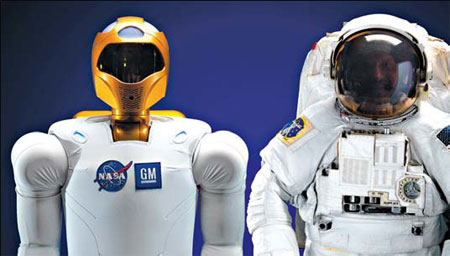
A humanoid dextrous robot-at least the top half -already exists: Robonaut 2, developed by NASA and General Motors, is on the shuttle Discovery, which was delayed from a scheduled liftoff last week. Bound for the International Space Station, it will be the first humanoid robot in space. It is to help with housekeeping chores as NASA learns how astronauts and robots can work together. Eventually, a Robonaut is to take part in spacewalks.
Project M also draws on other NASA projects that were under way, including rocket engines that burn liquid oxygen and methane -a cheap fuel combination -and an automated landing system that could avoid rocks and other hazards.
Integrating the technologies into working prototypes sped up development. "That's the magic," Mr. Altemus said. "A lot of times technologies end up in the lab cooking, and then there's this valley of death where they never get to maturation or to flight."
Project M's planners say that a robot on the Moon would capture the imagination of students, just as the Apollo Moon landings inspired a generation of scientists and engineers 40 years ago.
"I think that's going to light a few candles," said Neil Milburn, vice president of Armadillo Aerospace, a tiny Texas company working on Project M.
But as NASA's attention turns away from the Moon, the prospects for sending a robot there are at best uncertain. And the quandary over Project M encapsulates many of the continuing debates over the future of the space agency: What should NASA be told to do when there is not enough money to do everything? What is the best way to spur advances in space technologies? And given the costs and dangers, how important is it to send people into space at all?
Last year, a special panel was reviewing NASA's human spaceflight program, in particular an ambitious project called Constellation to send astronauts back to the Moon. Although NASA has spent $10 billion on Constellation, most of the program is to be canceled when Congress finishes work on the 2011 budget. Sending a robot to the Moon is far easier than sending a person. For one, a robot does not need air or food. And there is no return trip. The thousand-day deadline was arbitrary, said R. Matthew Ondler, Project M's manager.
"It creates this sense of urgency," he explained. "NASA is at its best when it has a short time to figure out things. You give us six or seven years to think about something, and we're not so good. Administrations change and priorities of the country change, and so it's hard to sustain things for that long."
The project sparked interest among the International Space Station managers, which is why a Robonaut is heading there. "I'm excited to see how we can evolve the technology in space and actually have a pair of hands and a working humanoid dextrous robot on the space station," Mr. Altemus said. "It's a big move forward for the agency."
The New York Times
(China Daily 11/14/2010 page11)