Financial crisis no excuse for climate inaction
Updated: 2011-11-28 09:55
(Xinhua)
|
|||||||||||


BEIJING - Policy-makers in advanced economies from Brussels to Washington are preoccupied with fighting a protracted and devastating financial crisis, but economic hardship should be no excuse for inaction on climate change.
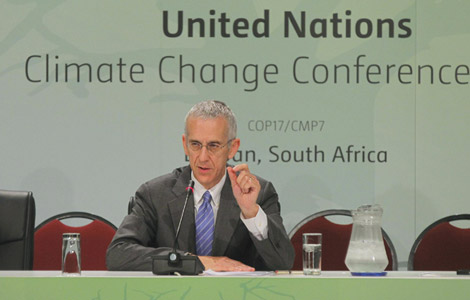
In Durban, South Africa, delegates from around the world are gathering to seek solutions as the Kyoto Protocol, the world's only legally binding document on climate change, faces the possibility of extinction when its first commitment period expires in 2012.
The ongoing global financial crisis casts a long shadow on the already frail prospects of reaching a "second commitment period" of the Protocol. That's as the crisis and ensuing fiscal strains may further hinder some Western nations' willingness to make environmental commitments.
Even before the opening of the 17th Conference of the Parties to the UN Framework Convention on Climate Change (COP17) in Durban, developed countries Canada and Japan have said "no" to expanding the Kyoto Protocol; Britain thought hope was frail, while for the United States, the Protocol is not even on its negotiations table.
For some developing nations, especially a number of small island countries, climate change is not an issue of becoming wealthier or poorer, but a matter of survival or extinction. This is truly unfair as those countries are normally low in industrial development level, and carbon emissions isn't one of their specialties.
For the whole world, fighting against climate change is an inherent need for countries to reduce environmental costs, sustain growth and relieve burden on people's lives.
The Durban conference, to be a success, should make substantial progress in working out a second commitment period of the Kyoto Protocol while preserving the pinciple of common but differentiated responsibilities.
Developed countries must fully take up their responsibilities as they have emitted the majority of greenhouse gases over the course of history. From 1900 to 2005, the developed countries' per capita cumulative carbon emissions were several times higher than those of the developing nations.
As the most industrilized country in the world, the United States' per capita carbon emissions still much higher than the world average. The world's No. 1 developed country has not yet embraced the Kyoto Protocol.
This time in Durban, developed countries must focus on making real pledges and honoring their commitments to transfer funds and technologies to developing nations. That's to help the developing nations better fight climate change, rather than skillfully distract the media's attention by finding scapegoats amongst their lesser brethen.
Some developing countries have been making strenuous efforts in the environmental field.
China, as the largest developing country, has aimed to reduce per-unit GDP greenhouse gas emissions by 40 to 45 percent in 2020 from 2005 levels. The country also has made addressing climate change an important task in the next phase of its social and economic development program.
With or without the financial crisis, when it comes to saving Planet Earth, nothing should be an excuse.



Hot Topics
HIV/AIDS, Egypt protest, Thanksgiving, climate change, global economic recovery, home prices, high-speed railways, school bus safety, Libya situation, Weekly photos
Editor's Picks

|

|
|

|

|

|

