Arguments to abandon Kyoto Protocol untenable
Updated: 2011-12-01 11:18
(Xinhua)
|
|||||||||||


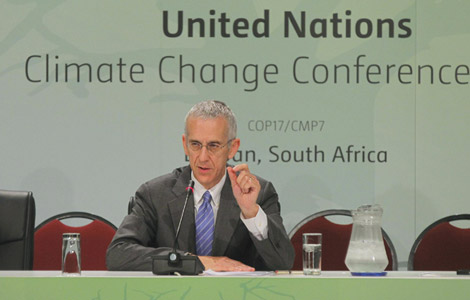
BEIJING - As negotiators are gathering in Durban, South Africa, to push for new progress on global efforts to deal with climate change, divergent views emerge over the fate of Kyoto Protocol.
As the cornerstone of the climate regime, Kyoto Protocol sets binding targets for 37 industrialized countries and the European Union to cut their emissions to an average of 5 percent against 1990 levels over the 2008-2012 period.
As the first commitment period is to expire in 2012, some signatory countries have not only backed down from their previous emissions cuts commitment, but refused to renew their pledges beyond 2012.
They argue that Kyoto Protocol, an agreement adopted more than a decade ago, is a thing of the past and could no longer reflect a changing reality.
Thus a global deal, which moves beyond the distinction between rich and poor countries and commits all the major emitters to binding emissions targets, is needed, they said.
Their arguments are untenable and far-fetched. For a start, developed countries are responsible for most of the greenhouse gases (GHG) in the atmosphere in its long and historical process of industrialization.
From 1900 to 2005, the developed countries' per capita cumulative carbon emissions were several times higher than those of the developing nations.
Thus, no matter how the current situation is changing, the developed countries' historical responsibilities for global warming are unshirkable, and they are obliged to continue to do their fair share in the fight against climate change.
In a statement at the ongoing UN climate talks on Monday, the International Union for Conservation of Nature also called on developed nations to shoulder more responsibility for tackling global climate change.
Secondly, under the principle of common and differentiated responsibilities, countries at different development stages are required to take different responsibilities to rein in GHG emissions.
Although some emerging economies, like China and India, enjoy a strong momentum of growth, their per capita GDP remains well below the world average.
China and India are doing their part to save planet Earth, but they also have the very right to development, which is recognized and ensured by the principle of common and differentiated responsibilities.
It is groundless to ask the emerging economies to take on emissions cuts commitments beyond their capacities and obligations.
Meanwhile, some developed countries are demanding emerging economies do more in emissions cuts, a move that looks more like a dishonest attempt to cover their own failure to honor their climate change commitments than genuine efforts to deal with the global challenge.
For example, under Kyoto Protocol, Canada, as a developed country, should significantly reduce its emissions from the 1990 levels. However, it registered an estimated 20-percent increase in GHG emissions above 1990 levels in 2010, according to the latest figures released by Environment Canada.
Against such a backdrop, some developed countries' calls for a new global deal which covers developing countries are rather like a tactic to dodge their due responsibilities.
Developing countries, though not bound by Kyoto's current targets, have made impressive commitments to promoting the green economy.
In 2006, China set a goal to reduce its carbon intensity in 2010 by 20 percent from that of 2005. In 2007, China became the first developing country to formulate and implement a national program to address climate change.
China also enshrined the targets of climate change in its 12th Five-Year Plan for 2011-2015.
As countries are racing against the clock to rescue Kyoto Protocol, a second commitment period is crucial to united global efforts to tackle climate change. Inaction, no matter under what excuse, is not what we can explain to future generations.



Hot Topics
HIV/AIDS, Egypt protest, Thanksgiving, climate change, global economic recovery, home prices, high-speed railways, school bus safety, Libya situation, Weekly photos
Editor's Picks

|

|
|

|

|

|

