
 Comments()
  Print
Print  Mail
Mail  Large Medium Small
分享按鈕
0
Large Medium Small
分享按鈕
0Today, anyone with a wad of cash and a sense of adventure can dive to the Titanic's deepsea grave, but behind these tourist jaunts lies a long and daunting tale of scientific endeavor.
After the Titanic sank on April 15, 1912, schemes proliferated for salvaging it - from packing the ship with pingpong balls or using magnets or balloons to bring it to the surface.
 |
|
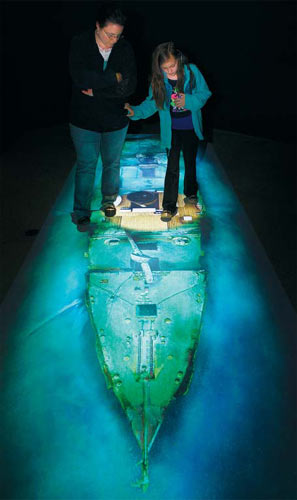
Tourists walk on an interactive display that changes as you walk on it, showing the deck of the Titanic at National Geographic's "Titanic: 100 Year Obsession" in Washington, DC on March 29. [Photo/Agencies]? |
The honors went to French and US researchers whose rigor, perseverance and game-changing technology led them to the grave of the greatest ship of its time.
"You need good tools and a good historical study to know where to search," said Jean-Louis Michel, the engineer who was the first person to see images of the wreck.
Michel was one of a team from the French Research Institute for Exploration of the Sea (Ifremer) and the Woods Hole Oceanographic Institution in Massachusetts.
On July 10, 1985, they set out aboard the French research ship Le Suroit on a quest to find the legendary wreck.
"In terms of sonar we had the best in the world and ... the Americans had developed a vehicle with a highly sensitive camera - the best in the world," he said.
"So by bringing together all these means and by sharing the cost of the research, it seemed possible."
The scientists collated every scrap of evidence they could find: logbooks from ships that had been near the disaster area, witness testimonies, weather and current data and information from searches in 1977, 1980, 1981 and 1983.
They narrowed the search zone to about 400 square kilometers, nearly five times the area of Manhattan.
The team cautiously lowered the new sonar and a magnetometer, a device that picks up magnetic anomalies caused by large metal objects.
Day by day, Le Suroit ploughed backward and forward, towing the array at a depth of 15 to 20 meters above the seabed, scanning strips of floor a kilometer wide.
On Aug 25, with Le Suroit called to other duties, a WHOI vessel, the Knorr, took over under oceanographer Robert Ballard.
He deployed a remote-controlled, deep-sea vehicle called Argo, fitted with cameras - a huge and costly innovation at the time.
On Sept 1, watching the screen aboard the Knorr, Michel became the first person in more than 73 years to see the Titanic.
"The first thing I saw was anomalies on the sea bottom. The structure of the sea bottom was changing," he recalls.
A few meters later, he spotted a "shining reflection" on the screen - a sign of something metallic.
As the camera inched forward, "there was more and more metal, and in the metal we recognized some pieces of railing ... it was pieces of ship".
Despite the stunning find, they were not yet sure it was the Titanic.
"Next step, we arrived on big pieces of metal ... and a few meters later we were on the biggest structure, four meters in diameter, eight meters high, in fact it was a boiler and I recognized it" from photos of the Titanic.
Reflecting on that "extraordinary" discovery, Michel said he felt achievement mixed with chilling solemnity.
"All those victims dying in the cold water, I was thinking of that. Because we were exactly there where they died."
The wreck had finally been found, broken in two, 21.2 km from the final SOS coordinates transmitted by the Titanic an error by its crew that had derailed all previous searches.
Today's sub-surface toolkit includes towed sleds, tethered remotely operated vehicles and autonomous underwater vehicles, says the WHOI.
Robots can peer into the ocean depths without the perils of extreme chill and crushing pressure.
Technical progress and money - are helping to satisfy man's urge to see things for himself.
Agence France-Presse
 |
|
Tourists walk on an interactive display that changes as you walk on it, showing the deck of the Titanic at National Geographic's "Titanic: 100 Year Obsession" in Washington, DC on March 29. [Photo/Xinhua]? |
Copyright 1995 - 2010 . All rights reserved. The content (including but not limited to text, photo, multimedia information, etc) published in this site belongs to China Daily Information Co (CDIC). Without written authorization from CDIC, such content shall not be republished or used in any form. Note: Browsers with 1024*768 or higher resolution are suggested for this site.
License for publishing multimedia online 0108263 Registration Number: 20100000002731