

 Comments
  Print
Print  Mail
Mail  Large Medium Small
|
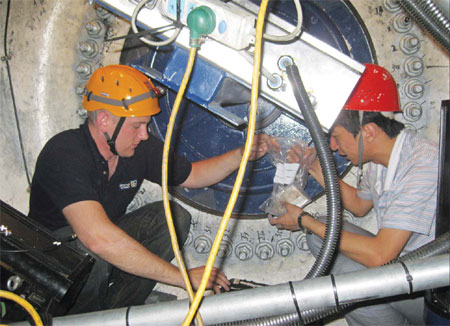
A Romax's engineer works with a client in China. Provided to China Daily |
British engineering firm has helped Chinese companies refine their technologies
The key to success in the renewable energy industry, says Peter Poon, CEO of the British engineering consultancy Romax Technology, is building a team of highly qualified engineers.
"Our advantage is our technology. We do consultancy work for companies with the best technology in the world, and we bring our expertise to China. To do so, we must build a strong team," Poon says.
Last year the company's recruitment team visited four Chinese cities to speak to students from five universities. The visit attracted more than 400 applications, but only six were selected.
Twenty-eight percent of Romax's software engineers and 18 percent of its mechanical engineers had PhD degrees before joining the company.
Poon founded the company in 1989 based on the mechanical engineering technology he developed while working as a fellow researcher at the Cambridge University.
Headquartered in Nottingham, in the English midlands, Romax's team has grown to 200 employees across seven countries, including India and Japan as well as North America.
Since it expanded into China in 2007, its sales have grown more than 25 percent. Its client base has also grown to include leading Chinese companies such as Chang'an Automobile and Sinovel Wind Group.
Today, Romax has four Chinese representative offices in Hangzhou, Beijing, Chongqing and Dalian, employing 30 staff, and generating sales of more than 3 million pounds ($4.5 million euros; 3.4 million euros) a year.
The company also hosts annual seminars for wind industry manufacturers and suppliers jointly with the Chinese Wind Energy Association, to introduce Western technologies to the Chinese market.
One milestone for Romax was its collaboration with Sinovel to develop the gearbox for a 3-megawatt offshore wind turbine, which was installed at China's first national-level offshore pilot wind farm, the Shanghai East Sea Bridge Offshore Wind Farm, in 2009. The project represented a technology breakthrough for Sinovel and the Chinese wind industry because most of the wind turbines developed in China until then had been kilowatt or 1.5 megawatt wind turbines.
In the collaboration, Romax focused on the gearbox's design, prototyping and test support. It also trained Sinoval's employees to help them understand the technology.
"We saw great opportunities in China's wind industry following the Chinese government's incentives to encourage renewable energy development in recent years," Poon says.
Under China's current Five-Year Plan (2011-15), the government has set a target of cutting carbon dioxide emissions by 16 and 17 percent per unit of GDP, creating financial incentives for companies to develop non-fossil fuel energy.
Romax has also helped CSR Qishuyan Institute, a research-focused subsidiary of the state-owned electric locomotive manufacturer CSR Corp, to create wind energy technology.
The partnership began in 2008 with CSR Qishuyan Institute's employees being trained at Romax's UK headquarters.
Engineers from both teams later developed a 2.8-megawatt wind turbine, which passed the Germanischer Lloyd certification, a German certification commonly regarded as the most stringent for wind turbines globally.
Liu Jie, general manager of CSR Qishuyan Institute, said at the time that Romax helped his team to develop a high quality gearbox that makes the best use of his company's local manufacturing facilities in China.
"(Romax's help) allowed us to control costs without compromising product quality," Liu says.
Romax has also helped many Chinese automotive companies improve their drivetrain technology.
One such company is Chang'an, which began working with Romax in the early 2000s when Chang'an's transmission subsidiary first started using Romax's design software.
The relationship between the two companies continued in 2008 when Romax worked with Chang'an to improve its transmission technology. In 2009, Chang'an asked Romax to help in setting up a research and development center abroad.
"They were looking at the US, the UK, Germany and many other places. We provided them with statistics and facts about the business environment of each location to help them make a decision," Poon says.
"They wanted to set up in an English-speaking country and they wanted to set up in a cosmopolitan city so it's easier for their Chinese staff to integrate into the local community. So in the end they chose Nottingham."
Poon's team helped Chang'an set up an R&D center in the Nottingham Science & Technology Park next to the University of Nottingham. Chang'an has since established a working relationship with the university's engineering faculty.
"The UK has great technology for engine transmission, which is why it has high-class vehicles like Rolls-Royce, Bentley and Jaguar. This is the technology Chinese companies can gain when they set up R&D facilities here," Poon says.
He says that Romax continues to do consultancy work for Chang'an in the UK and has helped Chang'an understand UK's regulations, including its labor laws.
Born in Zhejiang province, Poon moved to Hong Kong with his family at the age of two. He went to college in the UK, eventually receiving a PhD in mechanical engineering from Bristol University.
Despite having spent most of his life in the UK, Poon is passionate about helping companies from the Chinese mainland grow and integrate into the global environment of advanced technology.
As a member of the International Electrotechnical Commission Joint Working Group on international wind turbine gearbox standards, Poon brought the committee's annual meeting to China for the first time in 2010.
"I brought the meeting to China so that the IEC delegates could gain a better understanding of the rapid development of wind technology in China," Poon says.
The meeting took place in Hangzhou, a southern Chinese city best known for its beautiful West Lake, which is surrounded by willow trees, hills and pagodas.
"I choose Hangzhou because it is so beautiful. It is the city loved by Marco Polo," Poon says.
After the meeting, Poon took the delegates to see the China Wind Energy Expo in Shanghai and the Donghai Bridge Wind Farm.
Poon says that China's wind industry is growing at exponential rates, but he says the industry should focus on overcoming its current challenge with overcapacity.
According to the Global Wind Energy Council, competition between wind turbine manufacturers in China drove turbine prices down from 6,700 yuan ($1,077; 830 euros) a kilowatt in 2009 to 3,500 yuan a kilowatt in 2011.
"Such competition leaves wind turbine producers with low profit margins, which means they will not have enough profit to invest in technology, but investing in technology is very important for the industry's growth," Poon says.
"But I believe, over time, there will be mergers and acquisitions in China's wind industry to create more powerful players who will be more capable of investing in technology. China is very important for Romax, and we are keen to help our Chinese clients achieve this."
Contact the writers at
cecily.liu@chinadaily.com.cn and zhangchunyan@chinadaily.com.cn
(China Daily 03/22/2013 page19)

 Hawaii legalizes gay marriage
 Graduation celebration for Santas
 One World Trade Center deemed tallest US skyscraper
 US honors its veterans with ceremonies, parades
 Carnival season kicks off in Cologne
 Typhoon Haiyan hits Vietnam
 UK's Royal Air Force marks ties with Bahrain
 Red Cross Red Crescent holds meetings in Sydney

Copyright 1995 - . All rights reserved. The content (including but not limited to text, photo, multimedia information, etc) published in this site belongs to China Daily Information Co (CDIC). Without written authorization from CDIC, such content shall not be republished or used in any form. Note: Browsers with 1024*768 or higher resolution are suggested for this site.
License for publishing multimedia online 0108263 Registration Number: 20100000002731