


 Comments
  Print
Print  Mail
Mail  Large Medium Small
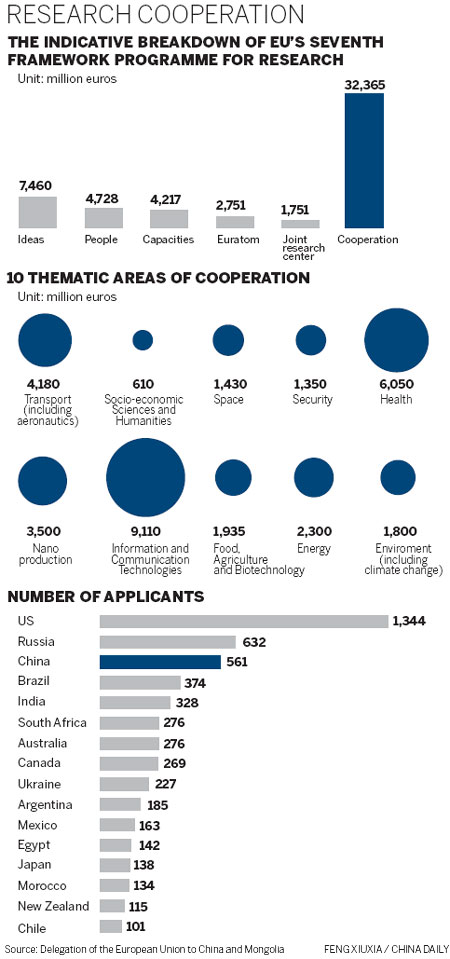
Under the FP7 framework, Chinese applicants - both from the CAS and other institutes in China - submitted 2,143 proposals, 561 of which were included in short-listed proposals, a success rate of 26.2 percent.
Chinese scientists are also closely involved in 10 thematic areas of cooperation with EU, such as socio-economic sciences and humanities, space, security, agriculture, food and bio-technology.
The collaboration under these programs also includes participation in EU multilateral projects through bilateral arrangements with different European countries.
Currently there are 34 joint laboratories set up by China and France to work on frontier technologies like bio-technology and medicine. "The EU vision is to let more countries join the research alliances, so that we can create a multilateral network," Vialatte says.
"We need to know more about each other. We want to make French science and technology better known in China, and Chinese science and technology better known in France," says Philippe Martineau, deputy counselor of science and technology at the French embassy to China.
"What we do is to develop a partnership on bilateral cooperation and find the right people for it. Ultimately we expect the bilateral cooperation to move into a multilateral partnership."
The International Thermonuclear Experimental Reactor, known as ITER, represents one of the largest-ever international collaborations of its kind. The project is funded and run by China, the EU, India, Japan, South Korea, Russia and the United States, and has 33 nations as participants.
China signed an agreement with the other six member countries in 2006, and now contributes 10 percent to the project, of which 80 percent is through in-kind input and 20 percent by way of capital.
"I think the ITER program is a good example of international collaboration especially in large infrastructure," Vialatte says. "ITER is all about nuclear fusion, and China is one of the key partners globally. There is very good collaboration in ITER, and we expect it to be an important project for the future."
Similarly, the advantages of multilateral cooperation have been evident in the European Laboratory for Particle Physics, better known as CERN.
Last June, CERN announced that they successfully found an elementary particle named the Higgs Boson, which is also called the "god particle" because of its significance in explaining why other elementary particles have mass.
The result was achieved through the efforts of more than 3,000 scientists from 175 universities or research institutions in 38 countries and regions. Ten Chinese research groups were involved in the program, making contributions to the detector construction and physics analysis.
"When we talk about infrastructure, we are talking about large-scale research infrastructure. We have a strategy forum in Europe to discuss large research infrastructure alliances, and we also have a roadmap that envisages participation of non-European researchers, particularly Chinese researchers," Vialatte says.
At the same time, since the 1970s, the Chinese government has attached great importance to the construction of large scientific facilities at home.
Nearly 34 large scientific facilities, involving a total investment of 5.3 billion yuan ($853 million; 667 million euros), have been set up till 2005. The government has also sped up development and construction of high-level facilities, with more than 6 billion yuan vested in large scientific facilities during the 11th Five Year Plan (2006-10).
Liu Minghua, director of the Bureau of Basic Sciences of the CAS, says more large scientific facilities are under construction, including the 500-meter Aperture Spherical Radio Telescope, High Magnetic Field Facilities and Research Facility of Protein Sciences.
CAS' Beijing Electron Positron Collider is one such high-profile infrastructure that has gained global recognition. On March 26, scientists working at the collider announced the discovery of an exotic state based on the collider experiment.
Physicists across the globe have been trying to find some form of exotic state, which is a particle that does not comply with the standard model of particle physics.
The new finding is expected to "open the door for more exotic states", scientists say.
Yuan Changzheng, coordinator for international cooperation in the team, says that the Beijing Electron Positron Collider has been attracting interest from research scientists across the world. "BEPC is actually the only running collider designed for the energy range that fits for charm physics study, which is a fruitful field to research," Yuan says.
He adds that interest has also peaked as many overseas laboratories are closing up their accelerators.
In May 2009 when the Chinese government started a project to upgrade BEPC, a magazine published by Fermi National Accelerator Laboratory in the US had indicated that more American scientists would eventually make use of the BEPC facilities and research.
"Like migratory creatures, researchers circle the globe in search of the best data, working on one experiment for several years and then moving on to the next, all in the hope of answering fundamental questions about the way the world works China's accelerator offers just such an opportunity," the report says.
chengyingqi@chinadaily.com.cn
(China Daily 03/29/2013 page20)

 Hawaii legalizes gay marriage
 Graduation celebration for Santas
 One World Trade Center deemed tallest US skyscraper
 US honors its veterans with ceremonies, parades
 Carnival season kicks off in Cologne
 Typhoon Haiyan hits Vietnam
 UK's Royal Air Force marks ties with Bahrain
 Red Cross Red Crescent holds meetings in Sydney

Copyright 1995 - . All rights reserved. The content (including but not limited to text, photo, multimedia information, etc) published in this site belongs to China Daily Information Co (CDIC). Without written authorization from CDIC, such content shall not be republished or used in any form. Note: Browsers with 1024*768 or higher resolution are suggested for this site.
License for publishing multimedia online 0108263 Registration Number: 20100000002731