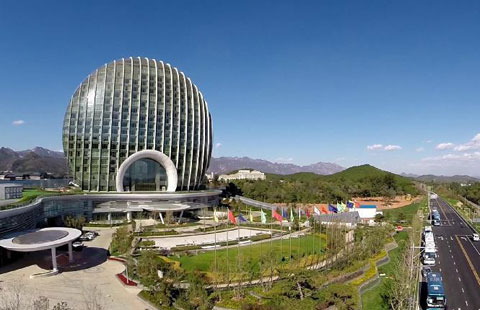
Mission and vision of APEC Beijing meeting
Updated: 2014-11-05 19:35
(Xinhua)
|
||||||||||


BEIJING - The upcoming APEC meeting in Beijing is expected to support economic growth and prosperity in the Asia-Pacific region, a goal that the 21 member economies of the premier economic forum have been dedicated to.
In a time of global financial turmoil and instability, the 22nd APEC Economic Leaders' Meeting, themed "Shaping the Future Through Asia-Pacific Partnership", will discuss major topics including regional economic integration, innovation and economic reform and growth, as well as infrastructure and connectivity.
The agenda, rather than being "tailor-made for China" to address Beijing's own priority concerns, as was accused by some Western critics, meets the common demand of all APEC economies. It was on the basis of democratic, transparent and thorough consultations that they were decided.
For a region faced with slower economic growth and a proliferation of Free Trade Agreements (FTAs), an in-depth look into those topics is imperative.
Seeking to promote free trade and economic cooperation throughout the whole Pacific Rim, APEC now has a significant and far-reaching relevance to the economic landscape of the Asia-Pacific and beyond. The importance of the regional economic integration, one of the 25-year-old APEC's major missions since its birth, can never be over-exaggerated when its 21 economies account for 57 percent of the world's total GDP and half the global economic aggregate.
However, the Free Trade Agreement of the Asia Pacific (FTAAP), an attempt to integrate regional cooperation mechanisms proposed nearly a decade ago, remained a mere "vision" until today. Despite the fact that the average tariff level in the Asia-Pacific has drastically dropped over the past two decades, the "spaghetti bowl" of overlapping FTAs harms trade by increasing transaction costs for business through variable tariffs, complex rules of origin and assorted bureaucratic requirements.
Beijing has said that the APEC meeting this year will see the launch of the FTAAP process to turn the long-standing vision into concrete actions. A feasibility study and a road-map for the overruling free trade agreement are expected to help explore the possible interaction and coordination among other regional FTAs visions, such as the RCEP and TPP.
The Asia-Pacific region, widely regarded as an engine driving global economic growth, was also where the two latest global financial crises prevailed. In the post-crisis era, the APEC meeting in Beijing will see discussions on economic reform and innovative growth. Dialogues in such frontier areas as Internet economy, urbanization and maritime economy will also be on the agenda.
Reform is where the economic growth originates while innovation is the key for the growth. For APEC economies, commonly tasked with shifting growth model and fostering steady growth, an accord on promoting innovative development, economic reform and growth at the meeting will have a lasting impact on its future.
With its enormous economic scale, APEC is at the same time wary of the huge gaps among its members, a majority of which are developing countries. The regional economic development hinges on the connectivity of the physical infrastructure, of the standards and technology, as well as of the personnel, with the most prominent problem being lack of funds.
The latest good news is that 21 Asian countries, including China and India, signed an MOU to set up the Asian Infrastructure Investment Bank last month. The establishment of such a multilateral financial institution will provide a strong backing for the Asia-Pacific's infrastructure construction and, in the long run, its overall development.
Profound changes have taken place - geopolitically, economically, and technologically - since 2001 when China for the first time hosted APEC events in Shanghai.
Though already the world's second largest economy, China still craves a more peaceful and fairer environment which will bring benefits to itself and the entire region as their interests have never been so closely intertwined like today.
China's growing presence and greater responsibility at APEC will only better benefit the Asia-Pacific community of common destiny and shared interests as a whole.