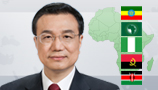
Full Text of Chinese Premier Li Keqiang's speech to British think tanks
Comments Print Mail Large Medium SmallLONDON - Visiting Chinese Premier Li Keqiang on Wednesday delivered a speech to British think tanks.
The following is the full text of Li's speech.
Inclusive Development: A Better World for All
Speech by H.E. Li Keqiang
Premier of the State Council of the People' s Republic of China
To British Think Tanks
London, 18 June 2014
The Royal Institute of International Affairs, known as Chatham House, and the International Institute for Strategic Studies are well-known around the world. Today, you are hosting this event together. This shows the great importance you attach to China and is a reflection of inclusiveness.
Inclusiveness is the mark of human civilization and progress. Chinese thinkers before the Qin Dynasty valued the notion of harmony without uniformity and believed in peace as being the most precious. This coincides with the belief of ancient European philosophers that harmony generates justice and kindness. The history of human development shows that the Eastern and Western civilizations, though of different origins, both appreciated the importance of harmonious coexistence, inclusiveness and mutual learning. Inclusiveness and common development are needed all the more in the 21st century. We need not only to increase employment and promote balanced, coordinated, fair and equitable development within a country. We also need to achieve development that features peaceful coexistence and common growth among countries and regions. Inclusive development should indeed be a common goal pursued by all countries in the world.
The world is paying great attention to China. There are all kinds of views about China' s economic growth. A line from a Chinese poem reads, "A mountain, when viewed in face, may look like a range; when viewed from the side, it may look like a peak." That means a mountain, seen from different angles, will leave people with different impressions. What it implies is that different conclusions may be drawn when people see things from different perspectives. The UK is the first to complete industrialization while China is the biggest developing country in the world. I believe your interest in China is actually about whether the world can achieve inclusive development. China' s pursuit of a new type of industrialization, informationization, urbanization and agricultural modernization is a pursuit of inclusive development on the biggest scale in the world.
After more than 30 years of reform and opening-up and through hard work of our people, China has steadily improved the lives of its 1.3 billion people, lifted over 600 million people out of poverty and ensured the people' s right to survival and development. China' s development has been achieved in an open environment. The firm goal of our 1.3 billion people is to achieve modernization, which will be a long journey. China is the second biggest economy in the world, but it ranks after 80th in the world with a per capita GDP of US$6,800. In China' s vast central and western as well as northeastern regions, per capita GDP is slightly over US$5,000 and it is a mere US$3,000 in some western provinces. Some 200 million Chinese still live below the poverty line by World Bank standards. At the same time, fast economic growth has been accompanied by a growing pressure on resources and the environment. These will remain our difficulties and challenges in the long run. To achieve modernization, it is important to complete industrialization and urbanization. This is exactly what the Chinese people are working for at present and for some time to come.
First, on China' s urbanization.
In the past few decades, China' s urbanization has been advancing, but it is still lagging behind on the whole. Over 600 million Chinese are still living in rural areas. Due to inadequate financial resources and limited public goods, the 200 million rural migrants cannot enjoy the same public services as those who have been living in cities with urban residency. Between now and 2020, we need to grant urban residency to 100 million of such rural migrants, mainly in eastern China. We also need to encourage another 100 million rural residents in central and western regions to settle down in cities and towns nearby. In addition, there are 100 million Chinese living in run-down city areas, which need to be redeveloped at a faster pace. To address these three problems, each involving 100 million people, is a pressing task for China as it pushes forward the new type of urbanization.
But our challenges go beyond that. Even if we had solved all the above-mentioned problems for the 300 million people, we still have several hundred million of farmers who will move to cities in the coming years. This will be difficult to accomplish without over ten years or even longer and the tasks will only be more difficult on our way ahead. For any country to complete industrialization, it has to achieve agricultural modernization, raise agricultural productivity and, on normal cases, keep the percentage of agricultural population low. China will not be an exception. To have so many people move to live and work in cities in an orderly manner will be a long process. That is why we say that China will not be able to become a medium-level developed country and achieve modernization until the middle of the century.
Second, on China' s industrialization.
Industrialization is an important aspect of modernization. It took western countries over 100 years to achieve industrialization, while China has instituted a full-fledged industrial system in just a couple of decades. China now leads the world in the output of many industrial products. You are all familiar with goods "made in China" , but China mainly produces medium- to low-end products. It has to advance to a medium to high level in industrial development. Industrial upgrading will serve our joint response to climate change. It is also a natural choice for China if it is to break energy, resources and environment bottlenecks. China will pursue a new type of industrialization, advocate green and low-carbon development and step up efforts to conserve energy and reduce emissions so that Chinese products will be more energy-efficient and environment-friendly and China will achieve internally-driven growth through innovation. This will also bring huge business opportunities for the world. In the coming five years, China will import more than US$10 trillion worth of goods, and invest over US$500 billion overseas. Outbound visits by Chinese tourists will exceed 500 million. China will be happy to share its development dividends with other countries in the world.