Leaders discuss BRICS bank
Updated: 2014-07-16 02:23
By Zheng Yangpeng (China Daily)
Comments Print Mail Large Medium SmallInstitution would help developing countries finance infrastructure
 |
|
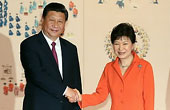
President Xi Jinping shakes hands with Brazil’s President Dilma Rousseff before the sixth BRICS summit in Fortaleza, Brazil, July 15, 2014. [Photo/Agencies] |
The widely expected BRICS development bank and contingency fund would alter the contours of global economic governance long dominated by the West, analysts said.
Talk has revolved around how much BRICS members (Brazil, Russia, India, China and South Africa) would fund the bank’s initial capital, where the headquarters would be and who would head them - details that might be unveiled following discussions by leaders at the ongoing BRICS summit in Brazil.
Analysts said the five emerging countries are frustrated by the failure of international financial institutions to fully meet their needs and are attempting to build something new to complement them, rather than replace them.
"These institutions, seen as counterparts of the Bretton Woods Institutions, the World Bank and the International Monetary Fund, are articulations of the growing assertion of the BRICS nations in the management of the global economy. But the most important aspect of this development would be that it is the first time such institutions are being established by the emerging economies," said Biswajit Dhara, an economics professor at Jawaharlal Nehru University.
Chen Fengying, director of the Institute of World Economic Studies at the China Institutes of Contemporary International Relations, said: "There are many suspicions. There will surely be problems. But what is important is to start the operation of the two institutions. No matter who says what, we have to do what we believe is right."
She said the core issue is that changing economic strengths among countries have not been matched by a revamped global governance structure. There have been some changes, such as the establishment of the G20 and voting right reform within the World Bank and IMF, but there have been few fundamental changes in deep-rooted values.
"I think South Korea keenly felt it," Chen said, referring to the country’s negotiation with the IMF for a bailout following the Asian financial crisis in 1998. "They had to accept so many rigorous conditions to secure funds. But when the crisis broke out in the US and Europe, nobody was talking about preconditions for bailouts, like there was nothing wrong that led to the crisis."
Huang Wei, a researcher at the Institute of World Economics and Politics under the Chinese Academy of Social Sciences, said the planned BRICS development bank would be different from the World Bank and Asian Development Bank. While those two focus on aid to alleviate poverty in the least developed nations, the BRICS bank would focus on development and infrastructure funding.
"India - the country with the lowest GDP per capita in BRICS - exited the World Bank’s aid program in 2012. The five nations have not qualified for most aid but they still have a lot of demand for development," Huang said.
The other institution expected to be proposed at the BRICS summit is known as the contingency reserve arrangement.
It could be used during market volatility and significant currency depreciation, but would have a complementary role, along with the IMF or a regional currency swap arrangement, according to Huang.
When a member is in crisis, the contingency fund would have requirements for bailouts, but it would focus on concrete issues rather than ideology, Huang said.
"Unlike other institutions that assign voting rights by GDP, China and other nations would pay an equal share to the development bank. That’s the Chinese style of doing things, and a way to demonstrate how China could be a responsible great power," Huang said.
Infrastructure fund
Also at the summit on Tuesday, Kirill Dmitriev, CEO of the Russian Direct Investment Fund, announced an initiative to form a joint fund to invest in BRICS infrastructure projects.
"Every BRICS nation has huge potential to develop infrastructure projects, as well as a great need to attract a large volume of equity financing from foreign investors," Dmitriev said.
"The joint fund can provide equity financing services for projects in the BRICS countries, which will complement the upcoming BRICS development bank," said Dmitriev.
"It is an important step to further strengthen the relationships among the BRICS countries."
The amount of financing for the joint fund will be announced in six months.
"Since infrastructure projects are traditionally capital-intensive, the size of the fund needs to be several billion dollars - but the scale of the projects can be much greater," Dmitriev added.
zhengyangpeng@chinadaily.com.cn
Cai Xiao contributed to this story.