Street of honor for time of tragedy
Updated: 2013-11-29 10:33
By Li Xiang and Zhang Jiayao (China Daily Europe)
Comments Print Mail Large Medium Small
|
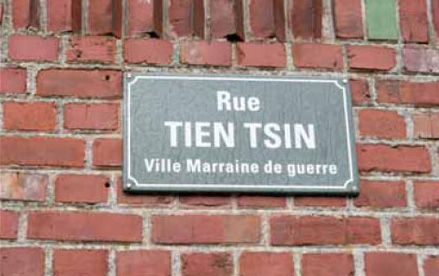 Top and Above: Albert's Tianjin connection is reflected in the street named after the North China coastal city, which was home to several foreign concessions early in the 19th century. Provided to China Daily |

A French town's wartime gratitude to a Chinese city is commemorated with a street name
Coming across rue de Tien Tsin in the town of Albert in northern France, few people would be aware of its origin. It is more likely to suggest a connection with French Indochina to the uninformed visitor or local.
Rather, Tianjin Street marks a historic link with the Chinese city that helped in rebuilding the town following its destruction during World War I.
A recent photo exhibition in Paris has rekindled memories and stories of the two communities nearly a century ago that would later become a symbol of Sino-French friendship.
Albert was a key location in the Battle of the Somme and changed hands several times between German and British-French forces during the course of the war. At the end of the conflict, the people of Albert were in desperate need of help to rebuild their home.
At the other side of the world in Tianjin, the port city 110 kilometers southeast of Beijing, an association was formed to collect donations for relief work in war-torn Europe. More than 20,000 in Tianjin, home to several Western concession areas, helped raise money.
Due to the efforts of a man named Pernaut, a French engineer who was an active member of the movement and a citizen of Albert, the French town became a beneficiary of a donation for the city's reconstruction.
In 1920, in gratitude for the generosity of Tianjin's citizens, Albert named one of its streets after the Chinese city.
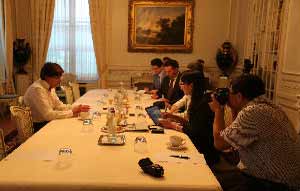
Organized by the municipal government of Tianjin and Albert, the exhibition, "France and Tianjin", held in Paris displayed some of the original pictures of the period.
"With a very distinct theme and rich content, the exhibition not only enables the French people to understand the touching story between our two countries but also inspires them to discover the city of Tianjin," says Bernard Accoyer, former president of the French National Assembly.
"I was touched by the story of Albert and Tianjin, which helped us recall the Sino-French friendship, and it is a very meaningful and timely event as the two countries will celebrate the 50th anniversary of the establishment of diplomatic relations next year."
Eric Coulon, vice-mayor of Albert, says the municipal government plans to move the exhibition to Albert next year.
"I did not know the origin of rue de Tien Tsin," he says. "The exhibition let us know of our historic link with the Chinese city, and I hope the friendship long continues."
Neither would most people be aware that at the same time France had a major influence in building 20th century Tianjin.
"In 1900, nine countries including Britain, France, Germany and Italy, set up foreign concessions in Tianjin, the entire area of which was eight times the size of old Tianjin city," says Jin Pengyu, director of Tianjin Protection Office of Characteristic and Feature Buildings.
"From early last century, foreigners constructed buildings in the concessions in their own architectural styles. A legion of European architects showed their talent and left us different styles of foreign buildings in our landscape."
The French quarter's contribution is particularly prominent - enough for promotion material to occasionally label it "Paris in Asia".
Tianjin's French historic relic area, in the central Heping district, features among its several gardens and parks 76 architecturally distinctive buildings, including the former French consulate, municipal board, club barracks, and the Quanye Bazaar, a large steel-built plaza that housed more than 200 merchants when it was opened in 1928.
The Albert exhibition includes photographs of the construction of another Tianjin building - the Museum Hoangho Paiho, founded by Emile Licent, a French doctor of biology, in 1923. It was the first natural history museum in northern China.
Photos of more recent Sino-French economic cooperation include those of the first joint venture between the two countries, the Dynasty Winery Co Ltd, formed after China's reform and opening up in the late 1970s.
Tan Duisheng, the minister counselor of the Chinese embassy in Paris, says the exhibition was a good way for visitors to discover the history and friendship between Tianjin and France.
"With a history of 600 years, the city of Tianjin has recorded some important and memorable historic events and changes that came along with the development of China," he says.
Those former French buildings in Tianjin witnessed many of these changes and development.
"The former French municipal board building on Chengde Street built in 1931 was luxuriously decorated and remains in tact," Jin Pengyu says.
"In 1945, the grand Japanese surrender ceremony was held there. After liberation, it became Tianjin people's library, then Tianjin Art Museum, and now it is the home of the bureaus of culture affairs and historical relics."
Contact the writers through lixiang@chinadaily.com.cn