Ethnic group's AIDS orphans forced to face adult responsibilities, reports Zhang Yuchen in Sichuan.
Waqi Wuji is reluctant to talk about her father. He died two months ago from an AIDS-related infection and the 14-year-old from the Yi ethnic group is still struggling to reconcile herself with the new situation.
 |
|
This 2011 photo shows pupils from a primary school in Longchuan county in Yunnan province watching a theater performance in Beijing. It was part of a trip to the capital at the invitation of Beijing Concord College of Sino-Canada. Many organizations have given a helping hand to those in need, particularly children in poverty-stricken or remote areas in China. Provided to China Daily |
The AIDS orphan, as youngsters such as Waqi Wuji are known, is not an isolated phenomenon in her home region. Children whose parents have died of an AIDS-related illness, or have been abandoned by the remaining parent after their spouse has died, make up a large proportion of the population.
She is not technically an orphan - she has an 11-year-old sister and a 16-year-old brother as well as their mother, 45, whose poor health prevents her from supporting her family - but circumstances mean that she has lost her only real chance of formal education and, therefore, a decent standard of living.
Waqi Wuji's educational career ended when she finished her Grade 4 primary schooling, immediately after her father was diagnosed with HIV\\AIDS three years ago. Tears rolled down her cheeks as she talked about missing her education. "I would like to support my family and I would like to go back to school," she said.
|


 |
Her daily jobs include helping her mother and brother work the fields and raise a pig that was donated to her family a year ago. Unlike other Yi households in the county, Waqi Wuji's family can't afford to raise a cow or an ox because they can't afford to pay the 3,000 to 7,000 yuan ($473 to $1,104) required to buy livestock.
"Oxen are important and precious property in a Yi household," said Zike Lame, the head of the county authority.
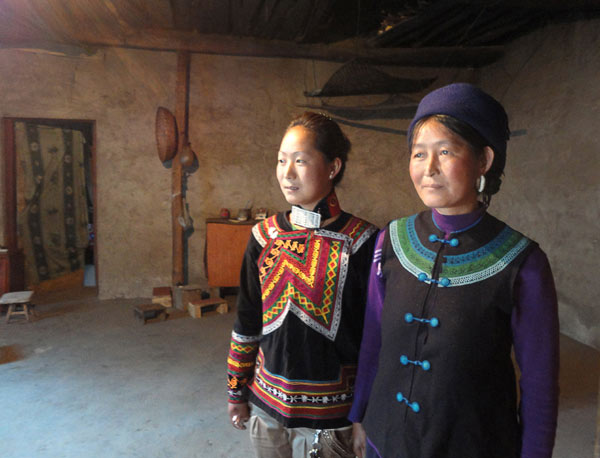
The flat house where Waqi Wuji and her family dwell is practically empty. The combined kitchen and living room contains little furniture, but it still qualifies as a typical middle- to lower-class Yi household.
Jida Geguo, Waqi Wuji's mother, barely understands Mandarin and cannot even pronounce her name in the language. Nihao, or "hello", is the only word she can say in Mandarin, so she always thanks the strangers who visit her home to offer advice and provide help with Kashasha, which means "Thank you" in the Yi language.
Hard Times
Jida Geguo is not alone. Very few of the locals in the region speak Mandarin at home, even though school lessons are conducted bilingually and all the signs in the county are written in both Mandarin and the Yi language.
"This presents children with great hardships when they grow up and try to move outside the mountains," said Li Yuan, a program manager for the China Children and Teenagers' Fund, who is in charge of training AIDS orphans in Sichuan province through the Spring Bud Project, which is aimed at helping young women return to school and acquire work skills. "Actually, in the process of training and helping them, we discovered that they are not accustomed to the outside world. In addition, they are severely homesick for their own culture," added Li.
"In the end, we find the best chance they have to make a living is to work in Xichang, the capital of Liangshan prefecture," he said. "If they can be trained to a sufficient standard, they will find a lot of good opportunities there."
In total, about 50 charitable organizations help to improve the children's work prospects by offering education or training facilities in Zhaojue county, Liangshan Yi autonomous prefecture, the biggest Yi group hub, situated in southwest Sichuan on the border with Yunnan province. Nearly all of the prefecture's residents, 97 percent, belong to the Yi ethnic group.
One of the 3 percent of non-Yi is Patrick Tsui, from Taiwan, who is the Zhaojue-based site manager of the social responsibility program of Micro-Star International, a US manufacturer of computer components and notebooks. Tsui has worked as deputy director of the Zhaojue youth center for 12 years, teaching basic and practical skills to help prepare kids for work in the cities. "Pragmatic living skills are what teenagers always need," he said.
 |
|
Waqi Wuji (left) and her mother Jida Geguo in their poorly furnished living room. The young woman has to help her mother support the family after her father died of an AIDS-related illness. Zhang Yuchen / China Daily |
Case numbers rise
The journey from Xichang, the capital of Liangshan Yi autonomous prefecture, to Zhaojue, where Waqi Wuji lives takes three bone-shuddering hours over rudimentary mountain roads. As travelers approach the center of the county, the number of signs for HIV/AIDS treatment clinics multiply.
The prefecture saw its first case of HIV/AIDS in June 1995 when an infected native came back from Yunnan province. By the end of 2010, the number of infected adults had reached almost 20,000 out of a population of 2.5 million, with 4,500 new cases registered annually, according to the prefecture office. However, unofficial estimates say the number could be much higher, possibly as many as 40,000.
The practice of drug users sharing needles was originally the prime method of transmission, but since 2001 sexually transmitted infections have emerged as a major factor.
Along with Butuo county, Zhaojue is the region most hit in terms of transmission rates. Both communities, officially designated as "poverty-stricken", have seen the work force dwindle as residents moved away to look for work in more developed regions. That huge outflux has made it harder to prevent and control the AIDS epidemic. "In the beginning, the ethnic people tried to make a living outside the Liangshan region, but the language barrier and a lack of education is a major obstacle to finding a job," said Yang Bin, the Party chief in Zhaojue. "Dealing drugs seems an easier job to them."
The region has 800,000 primary and middle school students who are exposed to the risk of drug use and HIV, according to the United Nations Educational, Scientific and Cultural Organization.
Scale of drug use
Hou Yuangao, a professor of sociology at Minzu University of China in Beijing, where the majority of students and graduates come from China's ethnic groups, who established the Yi Women and Children Development Center in Liangshan, was shocked by the scale of drug use when he first returned to his hometown in Zhaojue in 2001.
The biggest difficulty Hou faced was that the infected villagers were ignorant of the impact of the disease and continued to leave the area to search for work. "It is very hard for us to prevent them from transmitting the disease to other people," said Hou, "The facilities provided by the local government are available, but they just ignore them."
Waqi Zefu, 55, has three granddaughters, the eldest of whom is aged 11. The elderly lady's son-in-law, Suqi Guha, 26, is among the few staying in the village for long-term treatment for HIV/AIDS. However, at present there's nothing the program can do to ease the financial burden of her granddaughters, said Waqi Zefu, because it is aimed at girls aged 16 to 21 and her granddaughters are too young to qualify for help.
If she were to return to school, Waqi Wuji would need to pay tuition fees of 50 to 60 yuan every semester. As an AIDS orphan, Waqi Wuji receives monthly compensation for her loss, but it's not enough to allow her and her brother to return to the classroom.
When a teenage Yi girl approached Adam H. Schechter, executive vice-president at Merck and president of the company's Global Human Health division, on a visit to Xichang five years ago, her pleas for a chance to continue in school impressed him deeply.
The company became involved in China's first large-scale comprehensive public/private partnership, known as the China-MSD HIV/AIDS Partnership. The program provided advice on HIV and AIDS prevention, patient care, treatment and support, as part of its support for "China's Action Plan for Reducing & Preventing the spread of HIV/AIDS 2006-2010", but has now ended. However, Merck, in cooperation with the Merck Company Foundation and CCTF, will soon embark on another three-year training program aimed at providing work skills for 1,400 young women aged 14 to 21.
"We hope these young people will stay in Liangshan, so that the region can have an intelligent and skillful labor force," said Men Lingling, the human resources manager of Merck in China.
Along with Waqi Wuji, Tumu Erge, another Yi girl is now looking forward to taking part in the training program in July. "I believe I will learn skills that will enable me to earn my bread in the future and I am thankful for all the efforts people have made."
Contact the reporter at zhangyuchen@chinadaily.com.cn


Copyright 1995 - . All rights reserved. The content (including but not limited to text, photo, multimedia information, etc) published in this site belongs to China Daily Information Co (CDIC). Without written authorization from CDIC, such content shall not be republished or used in any form. Note: Browsers with 1024*768 or higher resolution are suggested for this site.
License for publishing multimedia online 0108263 Registration Number: 130349