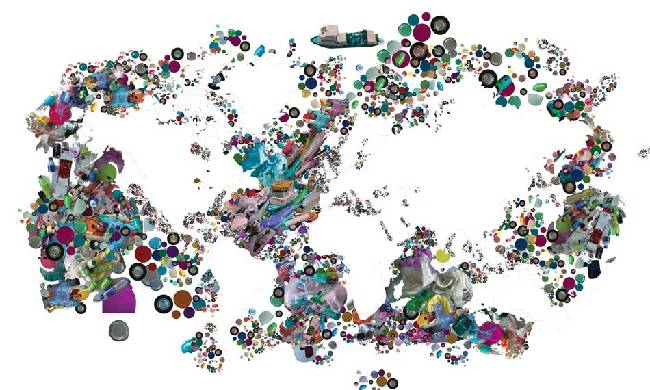
Rubbish at sea not only threatens shipping and marine life, but has the potential to cause severe harm to people, reports Yang Yang
Since Malaysia Airlines flight MH370 went missing in the early hours of March 8, teams of rescue workers have been frantically searching large swaths of deep ocean to locate the Beijing-bound Boeing 777-200.
|
How pollution affects marine life 300 6 80% 10,000 58% 43% 44% SPECIES 10% 86% |
However, so far their efforts have been fruitless. On March 26, Malaysian authorities announced that satellite images suggested 122 objects - ranging from 1 meter to 23 meters in length - floating in an area of 400 square kilometers could be connected to the missing jetliner. The objects were later discovered to be unrelated floating debris.
A few days later, Australian authorities dismissed the possibility that four orange objects spotted on March 30 were connected with the missing plane.
In the days that followed, aircraft involved in the search operation reported more than 10 sightings, which yielded no signs of the airliner, according to the Australian Maritime Safety Authority.
Although the floating, half-submerged debris has proved a hindrance to the search teams, the intense focus on the desolate ocean spaces has highlighted a long-term menace - one that not only threatens shipping and marine life, but also has the potential to cause severe harm to humans.
The southern Indian Ocean contains one of the largest man-made rubbish dumps on earth - the Indian Ocean Garbage Patch - discovered by Marcus Eriksen, a US marine scientist and founder of the 5 Gyres Institute, which works to reduce pollution caused by disposable plastic.
In 2010, Eriksen took a crew and sailed from Perth in Western Australia toward Africa to document the floating garbage dump, which the former US marine told National Geographic covers at least 5 million sq km, but has no clear perimeter.
The patch, composed of vast amounts of plastic debris from land-based or marine activities, rides the Indian Ocean "gyre" - a large, rotating ocean current that traps everything caught within its vortex. The gyre, which runs from the Australian side of the ocean, across to Africa and down the coast before spinning back toward Australia, switches between clockwise and counter-clockwise revolutions depending on the season. Each 360-degree rotation takes about six years.
The 11 known gyres cover 40 percent of the earth's oceans, and "all five subtropical gyres have garbage patches", wrote Eriksen in an e-mail exchange with China Daily, referring to the North Pacific gyre, the South Pacific gyre, the North Atlantic gyre, the South Atlantic gyre, and the Indian Ocean gyre.
In 1997, when Charles Moore, oceanographer and racing boat captain, was surfing in the northcentral Pacific during a voyage from Hawaii to the US mainland, he was disturbed by the sight of massive amounts of man-made debris strewn across the ocean, trapped by the endless swirl of the North Pacific gyre. Moore, the first person to surf the area, later dubbed the stream of trash, which lies between Hawaii and California, "The Great Pacific Garbage Patch".
The patch is the largest man-made garbage dump in the world's oceans; some researchers have estimated that it's the size of Texas, others have said it's twice that size, while some have even calculated it to be as large as the United States. No one is sure exactly how big the patch, facetiously called "the eighth continent", actually is.
"No (there is no definite conclusion). We find consistent amounts of plastic pollution from Japan to California. We sailed from Tokyo to Hawaii two years ago, and were surprised to find the garbage patch all the way across the Pacific Ocean," Eriksen wrote.
It's estimated that 60 to 80 percent of the marine debris carried by the five subtropical gyres is petroleum-based plastic, although other types of debris, such as glass floats, bottles and light tubing, tin cans and discarded fishing traps, nets and lines, can also be found, according to Eriksen.


Copyright 1995 - . All rights reserved. The content (including but not limited to text, photo, multimedia information, etc) published in this site belongs to China Daily Information Co (CDIC). Without written authorization from CDIC, such content shall not be republished or used in any form. Note: Browsers with 1024*768 or higher resolution are suggested for this site.
License for publishing multimedia online 0108263 Registration Number: 130349