|
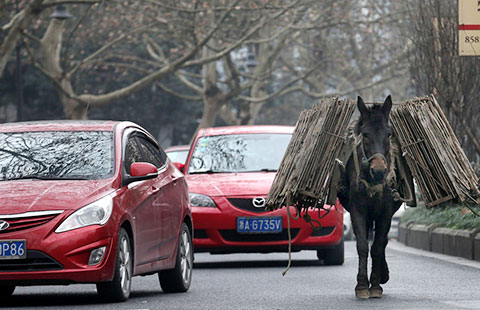
Beijing's roads in 1982 (left) and now. The municipal government is taking measures to encourage people to get back in the saddle. Photos by Wang Wenlan and Wang Zhuangfei / China Daily |
The government of Beijing is set to consider proposals to boost the number of cyclists on the city's roads and impose a congestion charge to slash the number of cars. Zhang Yuchen reports.
In 2001, when Ines Brunn first visited Beijing, she was impressed by the sight of millions of cyclists riding along wide, flat asphalt lanes separated from the sidewalks and main roads. The city's streets abounded with bikes, and during her short stay Brunn was thrilled to see so many cyclists in one place, so she decided to return.
However, in 2006, when she moved to Beijing to live and work, she discovered that the roads had been taken over by automobiles, and the number of cyclists had plummeted.
Her disappointment was compounded by the attitudes of her Chinese colleagues at a multinational company when she told them she cycled to the office every day.
"In their eyes, if you rode a bike you were really poor," Brunn said, recalling that she had already started working with a number of environmental NGOs to advocate the increased use of bikes. Since then, Brunn - who owns Natooke, China's first fixed-gear bike workshop, in Wudaoying near the famous Lama Temple - has spent much of her working and leisure time attempting to convince people that cycling is cool, socially responsible, and definitely not an indication of financial status.
"People were listening, but they didn't want to change. I realized the discussions were not changing people's attitudes toward bicycles," said the 39-year-old native of Iserlohn, a city in western Germany.
If people weren't listening to her back in 2006, they are certainly getting the message now, as the city is plagued by seemingly endless traffic jams and declining air quality. In response, as part of a series of "green transportation" measures, the Beijing government aims to make bikes account for 18 percent of the city's traffic by the end of 2020.
Expanding the focus
Targeting traffic congestion and air pollution, Beijing has planned a raft of policies to make the city a more livable place, and to provide a more sustainable mobility system.
This year, the city government will consider a proposal to trial a congestion charge in the capital, and although no details, such as cost or scope, have yet been announced, experts said the move could be regarded as the fulfillment of one of 28 measures, initiated in 2010 and reaffirmed in 2013, to curb traffic congestion.
In terms of traffic gridlock, Beijing is second only to the southwestern municipality of Chongqing, according to TomTom, a manufacturer of travel software. By the end of August, there were 5.58 million automobiles on the capital's roads, and the city had 9.65 million registered drivers, almost half the registered residential population.
Every day, traffic congestion accounts for 50 percent of the time spent commuting during the rush hours. Last year, a survey by the National School of Development at Peking University found that the economic loss caused by congestion was about 70 billion yuan ($11 billion), and 80 percent of that was the result of wasted time.
Since 2011, the city has spent 470 million yuan attempting to reduce urban congestion, but some critics say a change of focus is needed.
"It's time for a full-scale renewal of Beijing's entire urban transportation system," said Liu Daizong, China transport program director at the World Resources Institute, an independent, nonprofit organization that provides strategic management for sustainable cities and transportation.
"We can't continue to build more roads to manage the congestion problem. The more roads we build, the more drivers will aspire to use those roads," he said. "This should be changed to rebalance the benefits of the roads. We need a distribution-oriented method of managing congestion."
Competition for road resources between different vehicles is fierce, and experts say an efficient strategy is needed to encourage greener modes of transportation. The greater use of bikes has been heavily promoted since 2011, when the local government began trials of a cycle-sharing project and started advocating the Bus-Metro-Walk strategy.
Since the early pilot projects in two districts of Beijing, the program has grown and 800 rental stands with more than 48,000 bikes now dot the city, said Wang Jiachuan, associate director of the Beijing Transportation Information Center, who added that by the end of last year, the existing 454 km of designated bike lanes had been extended by 100 kilometers.
Cycle-sharing is about more than just transportation, according to Kim Lua, senior associate at World Resources Institute China Sustainable Cities, who said bikes are city friendly because their use results in fewer, and less serious, accidents and they don't cause pollution. "Promoting cycling as a transportation option can reduce the economic cost to the city. Using well-designed bicycle lanes to improve traffic safety could reduce the human cost," he said.


Copyright 1995 - . All rights reserved. The content (including but not limited to text, photo, multimedia information, etc) published in this site belongs to China Daily Information Co (CDIC). Without written authorization from CDIC, such content shall not be republished or used in any form. Note: Browsers with 1024*768 or higher resolution are suggested for this site.
License for publishing multimedia online 0108263 Registration Number: 130349