|
|
 |
|
30th Anniversary Celebrations
Economic Development
New Rural Reform Efforts
Political System Reform
Changing Lifestyle
In Foreigners' Eyes
Commentary
Enterprise Stories
Newsmakers
Photo Gallery
Video and Audio
Wang Wenlan Gallery
Slideshow
Key Meetings
Key Reform Theories
Development Blueprint
Li Xing:
Teachers like Li need our support  Alexis Hooi:
Going green in tough times   Hong Liang:
Bold plan best option for economy   Endless, ancient toil
By YOU NUO (China Daily)
Updated: 2008-07-14 15:07

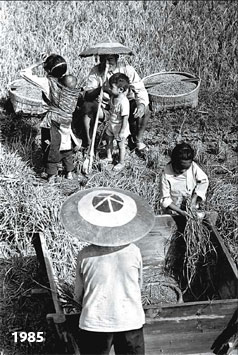
The two photos in our column this week have a difference of 20 years - the black-and-white one taken in 1985 while the color one is from 2005. For most economies in the world, 20 years don't usually show much difference. But for Chinese farmers, they are a world apart. Growing rice used to be a family affair, an intensive operation that frequently required at least several people to play different roles. This had been the case for eons (archeologists say people might have grown rice 7,000 years ago in some spots in the Yangtze valley).
But the practice, as we can see from the 1985 photo, lasted well into the 1980s in many parts of the country. From time to time, especially during harvest, the whole family would be working in the fields. Even the young kids were asked to run some errands. There was nothing idyllic about it. For families short of labor, teenagers dropping out of school was almost a matter of course - and the consequences, as can be easily imagined, would severely limit their opportunities to find a life beyond the countryside. Urban-based educators used to wonder, not so long ago, when the farmers could be liberated by machines or by something else, from so much work in the fields, so that their children could go to school and prepare for more creative jobs. A change has become widespread since the beginning of the 2000s. Urban jobs (sometimes disparaged as sweatshop pay in developed countries) have proved so attractive to rural youths that increasing numbers of them are leaving the paddy fields to work in the cities. The scene of a whole family working (and virtually living) in the fields is no longer commonplace. Attending the paddy is more often a lonely operation. Even in busy times, farmers just borrow (they do not usually say "buy") services from each other, in order to harvest the crops, to use farm machinery, and to build irrigation systems. These services are paid in part by the remittances from their children working in the distant cities. So far so good, it seems. But for agricultural specialists, this is by no means a secure system. Farming in China still has a long way to go to become truly modernized and efficient. Feeding more than one-fifth of the world's population still remains a challenge. As can be seen from one of our charts, private ownership of farm machinery is still low in Chinese countryside. And that amount of machine power has sustained the nation's grain output for so long. Chinese economists are anxiously waiting for new data showing the growing productivity of farmers.
  
|
       |
主站蜘蛛池模板: 商城县| 南木林县| 泸溪县| 柏乡县| 禹城市| 黔西| 镇坪县| 仁怀市| 宣武区| 仪陇县| 普兰店市| 武隆县| 固安县| 从江县| 吐鲁番市| 永泰县| 铜山县| 大名县| 湘西| 宁武县| 昌平区| 仁布县| 绥宁县| 泸定县| 漠河县| 鹤峰县| 葫芦岛市| 九江市| 毕节市| 高阳县| 嘉禾县| 巫溪县| 海阳市| 北碚区| 洛阳市| 龙川县| 沈丘县| 巍山| 佛山市| 阿坝县| 临城县| 珲春市| 芒康县| 襄城县| 德阳市| 绵竹市| 镇远县| 林西县| 游戏| 双鸭山市| 郧西县| 阆中市| 龙里县| 云安县| 东乌珠穆沁旗| 武功县| 吴旗县| 咸丰县| 明光市| 阜城县| 剑阁县| 麦盖提县| 潮州市| 宜兰县| 曲水县| 怀安县| 准格尔旗| 宁化县| 宁化县| 赣榆县| 漳州市| 深水埗区| 驻马店市| 化德县| 瑞丽市| 成都市| 桦甸市| 五家渠市| 朝阳市| 赣榆县| 蚌埠市| 双流县|