Will Obama use the 'new type of relations' term in China?









The biggest news from the shirt-sleeves summit between Chinese President Xi Jinping and US President Barack Obama in the Annenberg retreat at Sunnylands in Rancho Mirage, California, in June 2013 was a consensus to build a new type of major country relationship.
However, recent developments have indicated that senior US officials are at least reluctant to use the term these days, leading many to wonder whether Obama will mention the words in his talk with Xi in Beijing on Tuesday and Wednesday.
Over the past year and more, Chinese officials have defined the new type of relationship as non-conflict, non-confrontation, mutual respect and win-win cooperation.
They use the term to demonstrate that despite China's fast ascent economically and politically, the country is not seeking to become a hegemonic power. Chinese Ambassador to the US Cui Tiankai last Tuesday described the past conflicts between a rising power and the existing power as both wanting to fight for hegemony, thereby making conflict inevitable.
"But China's development is not to fight for hegemony with others," he said. "China's intention and goal is to develop itself and excel itself, rather than challenging others and conquering others."
Both Chinese and US officials have used the term often over the past year. In her Asia policy speech at Georgetown University last November, National Security Advisor Susan Rice said the US seeks to "operationalize a new type of major power relations" with China.
Last Wednesday, her predecessor Tom Donilon also talked about the new type of relationship in a speech at the Brookings Institution.
Just a day before Donilon's speech, Secretary of State John Kerry delivered a speech on the US-China relationship at the Johns Hopkins University School of Advanced International Studies in Washington.
The speech, in which Kerry described the bilateral relationship as the most consequential in the world today, set an overall tone that was quite positive before Obama's trip.
Careful listeners, however, would have noticed that his 40-minute speech did not mention once the words "new type of major power relationship".
The closest Kerry came to that concept was when he said that the two nations were collaborating to tackle some of the most complex global challenges the world has ever seen. "We're able to do that because together our nations are working closely in order to avoid the historic pitfall of strategic rivalry between an emerging power and an existing power," he said.
"Instead, we're focused on the steps that we need to take to ensure that we not only coexist, but that we cooperate," Kerry said.
Since Sunnylands, the two countries have tried to inject content into the new type of relationship, such as through the increasing military-to-military exchanges and a joint commitment to fighting climate change among the world's two largest greenhouse gas emitters.
Major differences such as in cybersecurity and tensions in the East and South China seas, which involves US allies Japan and the Philippines, have also prompted some US officials and pundits to think that the US understanding of the concept is sometimes different from the Chinese and it should not mean that the US is writing a blank check for China.
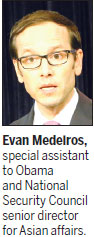
In a press briefing last Friday, Evan Medeiros, the special assistant to Obama and National Security Council senior director for Asian affairs, did not use the language either in his remarks.
When asked by China Daily and others, Medeiros admitted that Obama, other senior US officials and he himself have used the term. "The concept is very simple, which is, we believe that we want to create a relationship between the United States and China in which strategic rivalry is not inevitable," he said.
"In other words, it's not inevitable that a rising power and an established power are destined for a major power conflict. That's the core concept behind the new model idea, and we think that's a good thing," Medeiros said.
Medeiros pointed out that the question is how to build that kind of relationship. He said the US has consistently stated that it's about expanding the areas of cooperation while carefully managing differences and areas of competition.
He said Secretary Kerry made that idea very clear in his latest speech at SAIS. "So if that's what you mean by the new model, we're very much in support of that idea," he said.
Medeiros did not say if Obama would use the term in Beijing in his upcoming visit. But based on Kerry's and Medeiros's latest speeches, it looks like a big question mark.
Medeiros said the US does not engage in slogan diplomacy. "We don't feel the need to reiterate a particular term on any foreign policy question repeatedly," he said.
Contact the writer at chenweihua@chinadailyusa.com.
(China Daily USA 11/10/2014 page2)


Today's Top News
- Inclusivity critical for AI governance
- Massive response to latest bonds issue
- Control of precursor chemical exports tightened
- Xi greets Ouattara on reelection as Cote d'Ivoire president
- CIIE displays innovation, global confidence in China
- Nation set to sharpen focus on key sectors