Inclusivity critical for AI governance










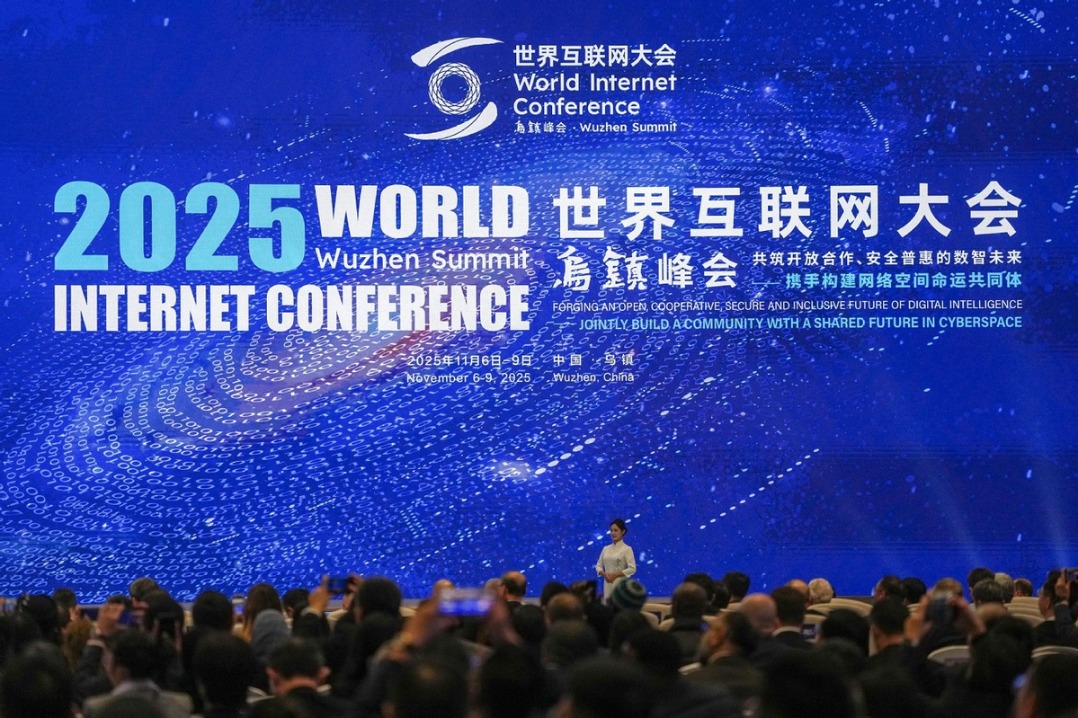
The conversation taking place at the 2025 World Internet Conference in Wuzhen unfolded when the international community is shaping a new foundation for global cooperation on artificial intelligence. The United Nations General Assembly's adoption of the "Pact for the Future" along with the "Global Digital Compact" and its recent work reflected in resolution A/79/L.118 on global governance of AI, underscores a principle that is difficult to ignore. AI will only contribute meaningfully to development if its governance is rooted in inclusion, scientific rigor and balanced global participation.
I came to this realization at the UN General Assembly in 2024 and 2025, where I observed firsthand how governments, experts and civil society grappled with the question of AI governance. Two decades earlier, in 2005, I participated in the World Summit on the Information Society in Tunis. At that time, the world confronted a deceptively simple question: who should guide the evolution of the internet, and how could its core resources remain stable, interoperable and accessible to all? The answer that emerged was not a single institution nor a top-down authority. It was a governance philosophy grounded in openness, transparency, shared responsibility and participation from every country and region.
Through my years serving on the boards of internet governance bodies such as the Internet Society, ICANN and AfriNIC, and my engagement in the Internet Governance Forum, I saw how this philosophy worked in practice. It allowed communities with vastly different realities to engage on equal footing. And it fostered trust, because legitimacy grew from inclusion rather than unilateral control. The internet's stability today is not an accident. It is the result of governance that welcomed diversity rather than feared it.
Artificial intelligence now demands the same discipline and humility. It is a technology that shapes education, health systems, financial stability, public services and the broader well-being of societies. Missteps can widen inequalities or weaken trust. Benefits can concentrate unevenly. For these reasons, AI cannot be governed by a few and accepted by the many. Its governance must reflect a shared global responsibility rather than a political priority for any single group.
Resolution A/79/L.118 speaks of this need with clarity. It calls for approaches that are scientifically grounded and globally representative. It highlights the importance of bridging capacity gaps so that countries at different stages of technological development can participate meaningfully, not only as adopters of AI but as contributors to its governance. It stresses the need for transparent, human-centric systems that respect rights and reflect cultural and linguistic diversity. And it emphasizes interoperability, so that the world does not fracture into incompatible AI regimes.
The spirit of the resolution reminds us that inclusion is not a symbolic gesture; it is a technical requirement. AI regulations shaped without the perspectives of developing regions will fail to account for real-world constraints, from infrastructure to skills to institutional maturity. And global debates that exclude voices from the Global South risk producing norms that are neither legitimate nor sustainable.
One useful way to understand these disparities is through what I describe as AI worthiness. It is a lens for assessing whether an ecosystem — national, institutional or sectoral — is prepared to design, deploy and oversee AI responsibly. AI worthiness examines readiness across four interconnected dimensions: governance and standards, talent and research, adoption and public value, and computation and infrastructure. These pillars draw their foundation from the United Nations' Global Digital Compact, which highlights the essential components needed to advance inclusive, human-centered and internationally coherent governance of artificial intelligence.
AI worthiness is a framework that highlights where progress is needed and where cooperation can be most effective. The concept mirrors the resolution's emphasis on capacity-building and balanced participation. When countries understand their AI worthiness, they can engage more confidently in global discussions. When disparities are mapped clearly, cooperation becomes more targeted and meaningful.
As I reflect on the early years of internet governance, I see parallels that are difficult to ignore. The internet endured because its governance allowed for inclusivity rather than exclusivity. AI, although vastly more complex, requires the same foundational principles. Scientific independence, transparency and interoperability are essential. But so is genuine participation across geographies, economies and cultures.
The coming years will determine whether AI becomes a catalyst for development or another source of division. The lessons from internet governance offer a clear path. When decisions are shared, trust grows. When all perspectives are welcomed, systems become more resilient. And when governance reflects the world rather than a fragment of it, technology has a better chance of serving humanity as a whole.
The author is founder and president of the Arab World Internet Institute.
The views don't necessarily reflect those of China Daily.
If you have a specific expertise, or would like to share your thought about our stories, then send us your writings at opinion@chinadaily.com.cn, and comment@chinadaily.com.cn.