Successful experiences behind Xi's confidence









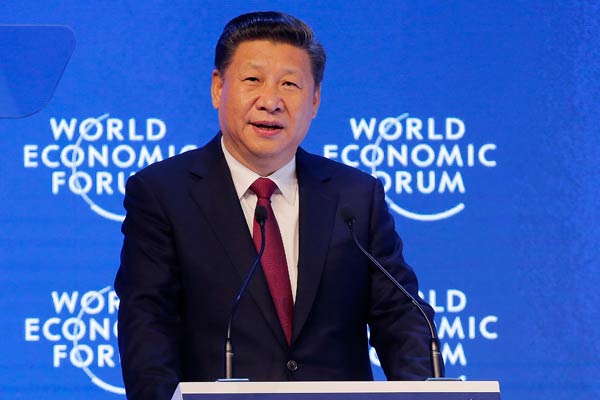 |
| President Xi Jinping takes the podium on the first day of the World Economic Forum in Davos, Switzerland, on Jan 17,2017. [Photo/Agencies] |
At a time when US and European leaders are losing confidence in the future, China's President Xi Jinping has boldly embraced it. This paradox, however, is the natural outgrowth of decades of successful economic policies in China contrasted with increasingly discredited and failed ones in the West.
Xi's comments to address the necessity of continuing opening-up during the annual sessions of the National People's Congress, China's top legislature, and the Chinese People's Political Consultative Conference National Committee, the country's top political advisory body, are of the greatest importance. They show China remains committed to peace and the expansion of global trade and investment.
The contrast with the unpredictable policies of the Donald Trump administration in the United States and the uncertainty sweeping the major countries in Western Europe could not be greater.
Britain, traditionally the US' closest partner in Western Europe rocked the entire European Union last year with "Brexit", demanding full withdrawal from the bloc. And since the outcomes of the elections in France and Germany are unpredictable, the two major EU economies look at an uncertain future.
Uncertainty has also roiled other major countries in Northeast Asia. The Republic of Korea's political stability has been rocked by the impeachment and removal of Park Geun-hye as president. In Japan Prime Minister Shinzo Abe continues to encourage potentially reckless nationalist and rearmament policies.
China cannot ignore the potential fallout from such political storms and possible momentous policy changes in other major countries and economies around the world. However, Xi continues to make clear that his priority goals remain to raise the standards of living of the Chinese people through sensible and constructive free market policies. And those policies are still working. China's projected 6.5 percent growth rate this year, though lower than its extraordinary rates in the recent past, remains unattainable and dearly envied by Japan and the US alike.
Xi's pledge to continue opening-up is not just a recommitment to past policies of stability and growth that have worked so well for so long; it also signals China's growing role as the locomotive of the world economy and its growing leadership role across Asia.
These remarkable developments are now inevitable: They are the natural outgrowth of China's economic and social policies consistently pursued now for close to four decades.
As I documented in my 2012 book That Should Still be Us, there is no substitute for the consistent encouragement and expansion of a country's primary industrial and manufacturing base. High-tech, so-called clean and intellectually prestigious sectors like the Silicon Valley are obviously of very great importance, but they cannot substitute for primary production and industrial capacity.
US leaders over the past two generations forgot this most elementary truth taught across the centuries in economic history. China's leaders took those lessons to heart and continue to apply them well.
China's policies continue to bring enormous benefits not only to its own people but also to hundreds of millions of people in other continents. China's continued economic growth is already the prime force driving economic growth and rising prosperity across sub-Saharan Africa and Central Asian countries. It is rapidly becoming comparatively important across Latin America as well.
China's current stability and continued commitment to international cooperation, peace and economic growth is therefore rooted in decades of successful domestic policies focused on raising the standards of living of her own people. The contrast between the positive results of these policies and the setbacks and instability in other countries should be evident.
The author is a senior fellow at the Global Policy Institute in Washington.