The philosophy behind culinary bitterness









Only a Chinese chef would serve up something bitter by design. It is a concept many Western chefs find hard to understand, because "bitter" is so rare in their kitchen lexicon.
Chinese chefs, however, believe bitterness is a cleansing taste that provides balance to a palate pampered by too much saltiness and an overindulgence in sweet food. Bitter is one of the five tastes in the Chinese kitchen, together with salty, sweet, sour and spicy.
The philosophy behind this can be summarized in an idiom: At the end of bitterness is a sweet aftertaste - kujin ganlai.
From childhood, we have been told that to suffer is good training for the future, and to be able to "eat bitterness" is a sign of maturity, and a ritual in life.
It is definitely an acquired taste.
Often, the first bitterness we taste comes from a bowl of traditional Chinese medicine designed to cure a litany of ills from fever to indigestion. The bitter brew would have contained a strange collection of ingredients - mainly herbs. But it would also often include mysterious minerals or animal parts.
I was a feverish child and often forced to drink pungent bowls of foul-tasting medicine. Strangely enough, the brews have tended to work. My personal theory is that the body breaks into a sweat at the prospect of more bitterness.
Of course, the reward of a pickled plum or a strip of hawthorn jelly after the medicine was also an incentive to pucker up and swallow.
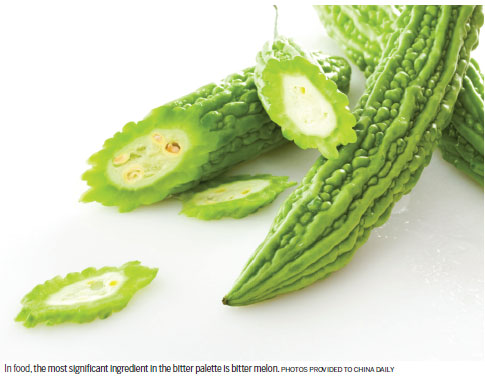
In food, the most significant ingredient in the bitter palette is a strange fruit called the bitter melon, or bitter gourd.
Momordica charantia is a pretty plant, a vine with delicate tendrils and large lobed leaves like a spread hand. It bears yellow flowers, which develop into fruits with deep ridges and warts.
The intensely bitter small, dark-green variety is harvested young, sliced, dried and used in infusions that help stimulate the production of insulin in the body. It is popular with Chinese diabetics.
Larger fruits are plucked when they are about 20 to 30 centimeters long and are used in cooking. They are braised, stir-fried and used in soups. On the island of Taiwan, a pale variety called White Jade is cultivated. Juiced raw, it is popular in the night markets as a summer cooler.
A long time ago, Chinese chefs also discovered the alchemy that happens when you pair bitter gourd with certain seasonings.
Douchi is a salted black bean that also tastes slightly bitter on its own. Yet, chopped up with garlic and chili it turns a bitter gourd stir-fry into a delicious temptation. Often, fresh fish slices or marinated beef add to the magic.
From a young age we were taught that there's a rule to preparing raw bitter gourds. You have to salt them before cooking to preserve the crunch and draw out excessive bitterness. After that, they can be used in salads, made into pickles, used in stir-fries or slow-cooked in soups.
Strangely enough, the bitter melon does not transfer its bitterness to the ingredients it is cooked with, and for that Chinese chefs call it the gentleman vegetable.
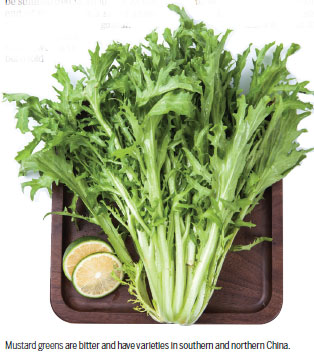
Mustard greens are also bitter. They are part of the choy sum family. A distant relative also produces rapeseed oil, or canola as it is known in the West.
In certain regional cuisines, the thick bitter stems are stripped of their leaves and marinated in brine. The resulting pickle is used as a seasoning ingredient.
My neighbors in Kunming of Yunnan province often grew their own leafy variety, which they called kucai, or simply bitter vegetables. They blanched the vegetables quickly and then ate them with a spicy-sour dip of hot chili oil, vinegar, peppercorns, chopped coriander leaves and prickly ash berries. It takes the roof off your palate but is strangely addictive.
In Beijing, mustard greens are a summer vegetable valued for their cleansing properties, especially on dusty, smog-filled days.
There are other bitter mainstays in Chinese cuisine such as beixing, the bitter apricot kernels. They have a low cyanide content and are used mainly in soup recipes. They are also used in traditional Chinese medicine as a cure for chronic coughs.
It may seem strange to the Western palate that bitterness should be purposely cultivated, but there is actually a lot of philosophy behind that.
A young child with tender tastebuds finds it hard to swallow bitterness, but with time and experience gradually develops a taste for it. Once you do, the five tastes in Chinese cuisine come full circle.
paulined@chinadaily.com.cn
(China Daily USA 04/21/2017 page9)






Today's Top News
- China, US hold maritime safety talks in Hawaii as Beijing reiterates warnings on sovereignty
- China sends letter to UN over Japanese PM's remarks on Taiwan
- Chinese, Uzbek FMs hold second strategic dialogue
- G20 an opportunity to strengthen Sino-EU ties
- China, Africa foster shared food security
- Japan urged to take practical steps to honor its commitments to China