Auto ambitions set to drive Belarus growth









The Eastern European country wants to produce its own cars on the road to development. Ren Qi reports from Minsk, Belarus.
Editor's note: This is the latest in a series of reports focusing on the development of the Belt and Road Initiative, the proposed trade route linking China with the rest of the world.
On a number of roads in the eastern outskirts of Minsk, the Belarusian national flag flies next to the Chinese one.
The roads lead to an industrial park the two nations are building to house domestic and foreign companies in the hope they will help Belarus upgrade its manufacturing industry.
Less than an hour's drive away, the Chinese automaker Geely has almost completed construction of a car plant, which will bring the Eastern European nation one step closer to its dream of a domestic auto industry.
The projects are of great importance to the Belarusian government's development plans, which China is looking to bolster, particularly through the Belt and Road Initiative.
Construction of the China-Belarus Industrial Park, 35 kilometers from downtown Minsk, began in June 2014. When the work is finished, the complex will cover 91.5 square meters, making it China's largest economic cooperation zone overseas.
First proposed in 2010, the park was visited by President Xi Jinping and his Belarusian counterpart, Alexander Lukashenko, on May 12, 2015.
"During the visit, President Xi said the park would be a bright pearl on the Silk Road Economic Belt," said Alexander Yaroshenko, chairman of the park's management committee, which is responsible for attracting investors.
"Ever since that day, May 12 has been designated Industrial Park Day," he added.
Favorable policies
The two countries have invested $5.6 billion in the park, and phase one is scheduled for completion by the end of the year.
To attract corporate interest, the Belarusian government has introduced a number of favorable policies. For example, businesses based in the park will be exempt from taxes on income, real estate and land use for the first decade, and after that, they will only be required to pay 50 percent tax for the next 10 years.
"Companies won't have to pay customs duties for the construction materials they use in the park, either," Yaroshenko said.
So far, nine companies have agreed to invest in the project - seven from China, one from Belarus and one from Austria.
The number could jump to 20 by year's end, according to Li Haixin, general manager of the China-Belarus Industrial Park Development Corp, which is in charge of infrastructure construction in and around the site.
Li said the project is targeting high-tech enterprises that will push development: "We especially welcome companies in high-end manufacturing, electronic information, biomedicines, new materials, fine-chemical engineering and warehouse storage."
In return, the park will offer access to markets in the European Union and the Eurasian Economic Union, which comprises Belarus, Russia, Armenia, Kazakhstan and Kyrgyzstan.
Industrial upgrade
Chengdu Xinzhu Road and Bridge Machinery, based in the capital of Sichuan province, is one of the Chinese companies already involved in the park. This month, it opened a research and development center in the complex as part of a joint venture with a Belarusian train manufacturer.
"The venture is researching supercapacitors," Li said. "The project is not just about manufacturing, but also about bringing high-tech manufacturing technologies from China to Belarus, which will help local industry to upgrade."
So far, the park's largest investor is China Merchants Group, which spent more than $500 million on 100,000 sq m of land to construct an office complex and three large warehouses.
"Under Belarusian law, foreign companies are only allowed to buy land inside the industrial park," said Huang Zhihua, head of the project, adding that potential clients for the warehouses include Chinese and Belarusian companies, and businesses from across the European Union.
First-phase construction of the development will end this month, so the number of workers has fallen from 600 to 400, according to Huang. In accordance with city government regulations, about 30 percent of the laborers are local hires.
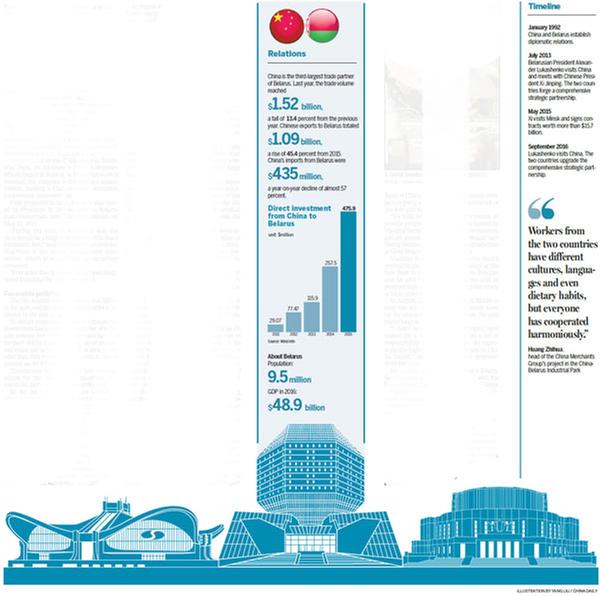
"Workers from the two countries have different cultures, languages and even dietary habits, but everyone has cooperated harmoniously," he said.
Qiu Haixiang arrived at the industrial park in spring last year as part of a team of 100 Chinese workers. He plans to stay until the latter part of this year.
"Working overseas is not as difficult as I'd imagined because the company takes care of everything," said the 34-year-old from Changzhou, Jiangsu province. "All we do here is work, but salaries are higher than in China."
Geely's initial investment in Belarus marked a milestone when the company opened the country's first auto parts plant in Minsk in 2011.
At the time, Belarus had no auto industry, and only made engines for heavy-duty vehicles, mainly because of the division of industry imposed during the Soviet era.
It has long been the government's dream to make cars in the country, and Lukashenko personally oversaw the Geely project.
Next month, the Chinese company will relocate to a brand-new 900,000-sq-m plant where foreign-made, high-end parts will be assembled to produce finished vehicles for the Belarusian market.
Most of the $320 million spent on the project was loaned by the Export-Import Bank of China, which supports Chinese companies going abroad under the framework of the Belt and Road Initiative.
"We hold two conferences every month to provide progress updates. They are hosted by Vladimir Semashko, the deputy prime minister, and are attended by several senior officials," said Cheng Wennong, deputy director of production at Geely Belarus, the local subsidiary.
Vladimir Pavlovich, assistant to the plant's general manager, said the technology at the new base is the most advanced in Belarus, and he and his Chinese colleagues aim to produce high-quality cars to satisfy the needs of local customers.
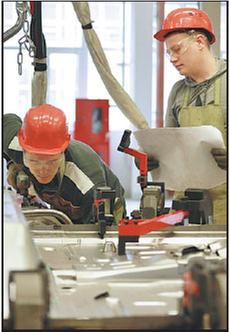
In August, Zhang Xiao arrived in Minsk to help test and calibrate the equipment used on the automated production lines. He also trains local workers.
"I don't speak Russian, so working here makes life a little lonely. But I feel a lot of responsibility because what we do represents the high standards of the made-in-China brand," said the 25-year-old engineer from Huainan, Anhui province.
Six months ago, Dmitry Khomich, a Belarusian national, left his job as a welder with the Minsk Motor Engine Factory and joined Geely.
Having been trained by Chinese technicians, Khomich is confident about the move.
"Belarus doesn't yet have its own car companies or experienced professional workers from the industry, that's why working for Geely is so attractive to me," he said.
"I had three months training in China, and I'm now working on my own to gain more professional and managerial knowledge because I believe this is a promising industry for Belarus, thanks to the Belt and Road Initiative."
Contact the writer at renqi@chinadaily.com.cn
|
|
(China Daily 05/11/2017 page6)