Xi gives best birthday gift to Hong Kong









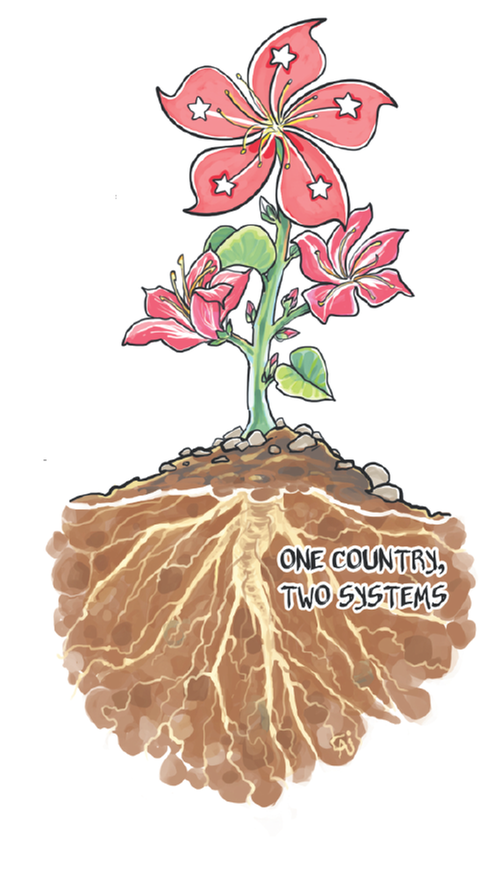 |
| CAI MENG/CHINA DAILY |
These remarks and fears are wrong as they overlook the key message delivered by Xi: "It has been 20 years since Hong Kong's return to the motherland. According to China's tradition, a man enters adulthood at the age of 20." To a child, "gifts" mean practical and materialistic support but to a man who is entering a new stage, what he needs most is wisdom to foster future development. Thus, what Xi said is more important than what he brought as a "gift".
First, Xi fully endorsed the SAR government's work in the past five years, which was not an easy period for the government. Political conflicts, accumulated social problems, challenging economic restructuring issues were all tough tasks to cope with. Facing these challenges, the government should be satisfied to have maintained economic and social stability. For those fuelling separatism, the Hong Kong government has delivered a clear message that there is no room for "Hong Kong independence".
That's why Xi told former chief executive Leung Chun-ying: "These five years have not been easy for you. You have made much effort in implementing (the principle of) 'one country, two systems' and the Hong Kong Basic Law." This recognition of past efforts is a great encouragement to not only Leung, but also all those who contributed to Hong Kong's stability and national unity.
Second, Xi emphasized the importance of upholding national unity while putting the "one country, two systems" policy to practice and issued a strong warning against separatism. How to fully and accurately put this policy to practice has been an important topic for Hong Kong; it will continue to be so in the future. In the past, Hong Kong residents focused much more on "two systems" putting the emphasis on Hong Kong's autonomy. Xi stressed that Hong Kong residents will need to be guided by a "strong sense of one country" and set a clear bottom line of "one country" which cannot be crossed.
He said any attempt to endanger China's sovereignty and security, challenge the power of the central government or use Hong Kong to carry out infiltration and sabotage activities against the mainland is an act that crosses the "red line", and is "absolutely impermissible". This key message will be a foundation of the development of the "one country, two systems" principle, and effective measures would be needed to stop separatist activities in the future.
And third, in his July 1 speech, Xi mentioned the history of Hong Kong, emphasizing that the city's destiny has always been tied with that of the motherland. He also said Hong Kong's return to the motherland is a monumental achievement for the Chinese nation. This message should instill more confidence in Hong Kong residents, especially those worried about Hong Kong's future.
In fact, the central government has strongly supported the SAR for the past 20 years. It has also created for the SAR favorable policies and development platforms, such as the Closer Economic Partnership Agreement, stock connects and the Greater Bay Area. But these opportunities can be fully seized only through the "one country, two systems" principle.
A Chinese saying goes: "Listening to the words of a wise man can be superior to studying 10 years of books." The gift brought by Xi, embedded in his keynote speech, is the key to the success of the "one country, two systems" policy.
The author is research officer at the One Country Two Systems Research Institute, Hong Kong.