Dialogue works better than threat on IP issues









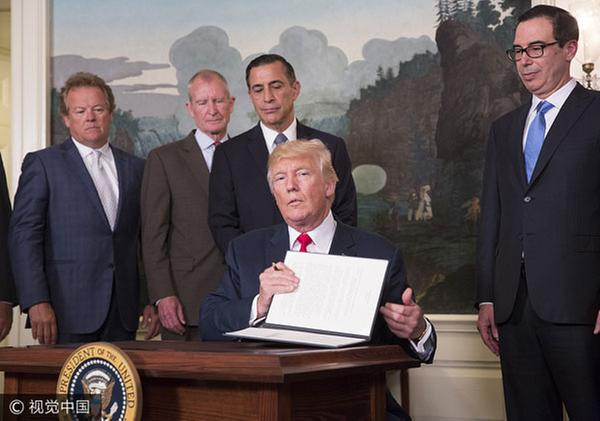 |
| US President Donald Trump signs a memorandum of understanding on addressing China's laws, policies, practices and actions related to intellectual property, innovation, and technology at the White House, August 14, 2017. [Photo/VCG] |
The United States has launched an investigation to determine whether China has indulged in "forced transfer of American technologies and theft of American intellectual property". US Trade Representative Robert Lighthizer subsequently announced an investigation into IP issues relating to China under Section 301 of the US Trade Act of 1974.
US President Donald Trump has termed it "a very big move". And he is right. It indeed is a big move-backwards.
Since the meeting between President Xi Jinping and Trump at Mar-a-Largo in Florida, both governments have established official channels for dialogue and working-level cooperation, including on IP issues. In fact, bilateral cooperation on IP protection has been yielding results for many years. The US and China both are signatories to the Agreement on Trade-Related Aspects of Intellectual Property Rights (TRIPS) under the World Trade Organization regime and other relevant international conventions. As such, the Trump administration can simply refer any IP issue to the WTO for resolution, instead of taking unilateral action under Section 301.
Section 301 authorizes the US Trade Representative to investigate if a US business has suffered unfair treatment in overseas markets, and to take action if it has. But Section 301 is a US law and does not apply to China or any other country. Therefore, any action on Chinese companies based on Section 301 will not have jurisdiction in China.
On the other hand, the WTO has a special agreement on IP in the form of TRIPS, which is binding on all WTO members, including the US and China. So IP issues involving China-US trade should be dealt with by TRIPS. Also, IP disputes between WTO members can be referred to the WTO Dispute Settlements Mechanism.
Apart from not being of any help to the US, the US Trade Representative's investigation under Section 301 will severely harm its relations with China. The US Trade Representative may seek consultation with China before the investigation. But it will not be a friendly consultation, as it is likely to be backed by a threat, which is uncalled for. And any punitive action by the US will result in a similar action by China, which will do neither country any good.
Moreover, it is a misunderstanding that high-tech foreign companies are forced to transfer technologies to their Chinese partners when investing in China. This has been denied both by Premier Li Keqiang and Minister of Industry and Information Technology Miao Wei.
If a case of forced transfer is proved, the concerned US company can provide evidence to the Chinese government to seek redressal.
According to the annual report of the US Chamber of Commerce's Global IP Center, China's IP index is 42 out of 100, which means China is ranked 17th among the 45 economies surveyed. China's score was less than those of the US, the United Kingdom, the European Union and Japan, but far higher than many developing countries'. The report noted that over the past year, China has introduced new mechanisms for IP protection and established IP courts, which has helped curb IP infringement and piracy.
The 2015 white paper of the US Chamber of Commerce in China said that only 22 percent of the members believed China's IP protection was satisfactory. But 82 percent of them praised China's progress in IP protection. In its 2017 white paper, the top five concerns of its members with regard to China were inconsistent regulatory interpretation, rising costs, increasing protectionism, shortage of qualified management, and difficulty in obtaining required licenses. IP issues have not been among the top five concerns in the past six years.
The findings show China's IP protection, though far from adequate, has been making great progress.
So instead of proceeding with the Section 301 investigation, the US Trade Representative should initiate an IP dialogue between Washington and Beijing as part of the bilateral dialogue mechanism based on WTO rules. And instead of raising trade tensions, the two countries should come together to reach an amicable solution.
The author is vice-president of and senior fellow at the Center for China and Globalization.
Source: chinausfocus.com