Laudable progress in advancing rule of law









 |
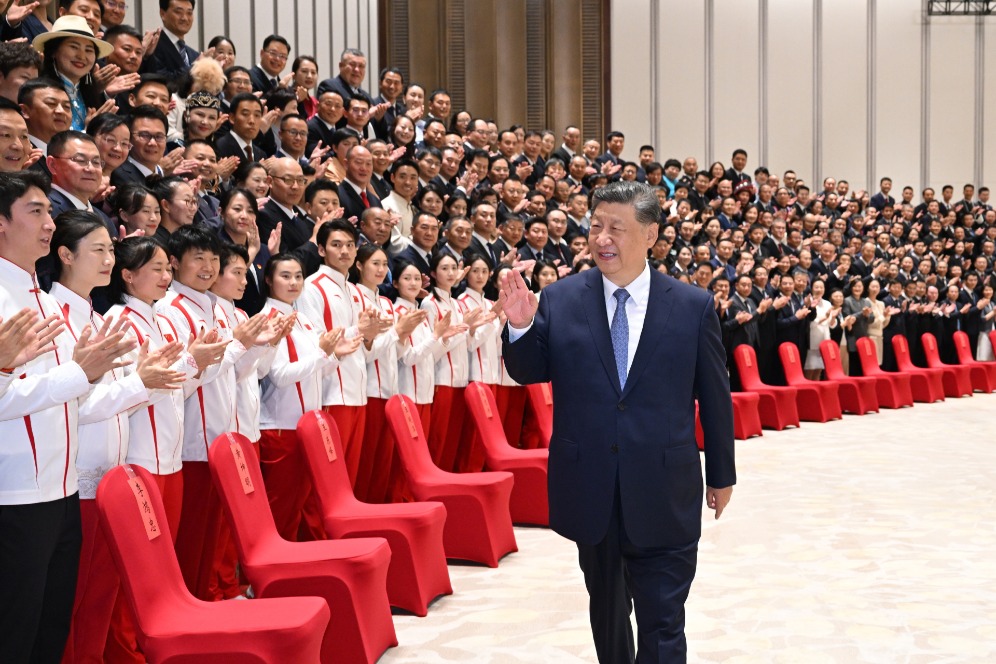
| Further efforts will be made to advance the trial-centered reform of criminal procedure, in addition to reforms in public security, state security and judicial administration, according to a recent written instruction from President Xi Jinping. Mao Siqian / Xinhua |
The highlights of the decision include deepening the litigation system reform with the focus on trials, and implementing the accountability mechanism to track cases and rectify erroneous court verdicts. So the establishment of circuit courts and the Intellectual Property Court by the Supreme People's Court should be seen as part of the legal reform.
Besides, legal education has been included in the national education system, and promotion of the rule of law made a yardstick to measure officials' political performance. Also, the State Council, China's Cabinet, issued a regulation in December 2016 that says local leading officials and Party leaders should be primarily responsible for advancing the rule of law, and their performance in this regard should be taken into consideration for their promotion. As a result, the local leading officials and Party leaders are not only focusing on GDP growth but also attaching great importance to advancing the rule of law.
The revision of the Legislation Law in 2015, which focused on the principle of law reservation, is a highlight of the promotion of the rule of law. The principle of law reservation means only the legislatures, not other bodies, can enact laws related to individual rights. The revision also strengthens the principle of statutory taxation, and forbids administrative rules and regulations to infringe individual rights.
The establishment of the National Constitution Day and a Constitution oath system is also worth mentioning, because they will enhance the importance of the Constitution.
Moreover, the revision of Administrative Procedure Law, the first since it was enacted in 1989, will make it less difficult for citizens to sue officials who fail to fulfill their official duties. And the General Provisions of Civil Law, which will come into force on Oct 1, will start the process of enacting a comprehensive civil code. Another major legal reform is the abolition of the "reeducation through labor" system.
The most significant institutional reform in China since the 18th National Party Congress is the launching of the national supervision system reform in November 2016, which is aimed at changing the long-standing basic Constitution system of "the government and the Supreme People's Court as well as the Supreme People's Procuratorate" to "the government, the Supreme People's Court and the Supreme People's Procuratorate, as well as a National Supervision Committee". It is the biggest administrative adjustment aimed at strengthening the supervision of public power.
The supervision system reform mainly focuses on three aspects. First is to integrate the different supervision mechanisms into a unified whole. Second is to hand over the national supervision authority to the National Supervision Committee. And third is to establish a special, unified and authorized national supervision organization, which will join hands with the Party's discipline inspection authority to jointly deal with relevant cases, in order to decrease legal disputes over supervision work.
The reforms of the past five years have helped build the basic framework of judicial reform. Judicial reform measures aimed at reducing litigation costs, including a case-filing system, have been introduced. As such, judicial service quality, and judicial efficiency and credibility have greatly increased.
In particular, several significant erroneous court verdicts, such as the one against Nie Shubin who was executed after being convicted of the rape and murder of a woman in North China's Hebei province in 1995, have been corrected.
The road to the establishment of a comprehensive rule of law is long, but China has already made great progress on that road.
The author is a research scholar at the School of Law, People's Public Security University of China.