Major country diplomacy bearing fruits









 |
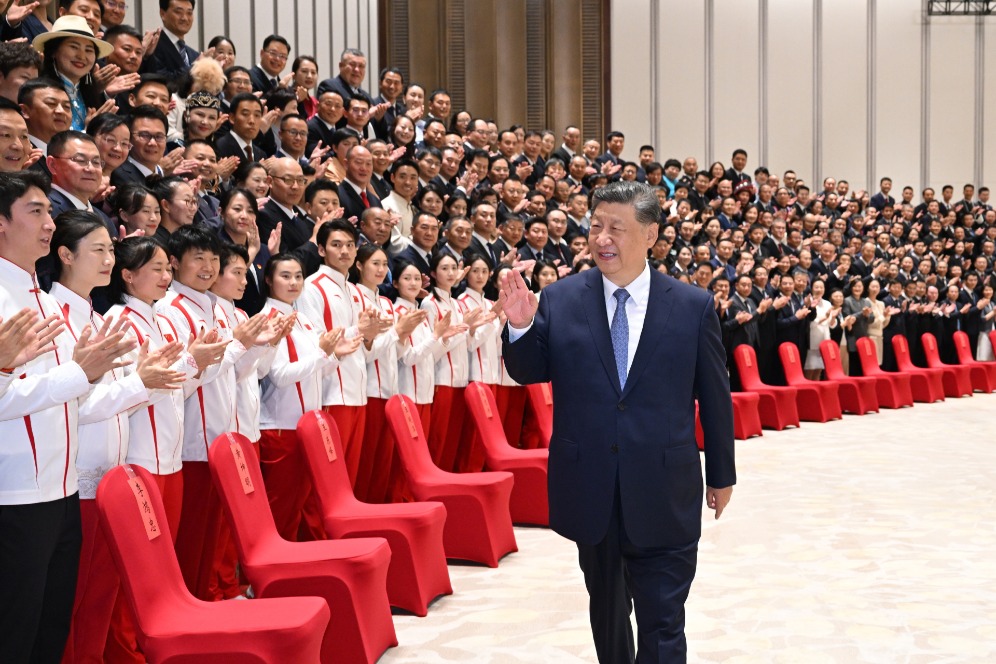
| President Xi Jinping, also general secretary of the Communist Party of China (CPC) Central Committee and chairman of the Central Military Commission, addresses the opening session of a workshop in Beijing. A workshop for provincial and ministerial officials was held in preparation for the 19th National Congress of the CPC. [Photo/Xinhua] |
And on Monday, China Central Television began the telecast of Major-Country Diplomacy with Chinese characteristics, a six-episode documentary summarizing the achievements of China's diplomacy over the past five years.
At the core of Chinese diplomacy is global peace and a stable neighborhood, which is necessary for the country's sustainable development and, of course, is a pursuit shared by all peace-loving nations. What really makes it stand out is its Chinese characteristics, from its socialist approach to its cultural inclusiveness.
China's rise as a peace-loving major power is evidence that its tailored socialist path, theories, institutions and culture have worked exceedingly well over the past decades. It also symbolizes the upgrading of the East-West political system that past leaders and diplomats pursued before the founding of the People's Republic of China in 1949.
Chinese characteristics do not mean Beijing's foreign policy is focused only on Chinese interests. Xi has vowed more than once to build a community of shared destiny with the rest of the world and advance globalization, while prioritizing Chinese people's well-being. The embedded Chinese characteristics, as Foreign Minister Wang Yi has said, are essentially a guarantee that China is striving to rise above the traditional role of emerging major powers.
Socialist institutions and development path, along with the adherence to the CPC leadership and socialism with Chinese characteristics, form the central premise of China's foreign policy. For decades, Beijing has been a staunch advocate of independent, peaceful diplomacy, the five principles of peaceful co-existence, and non-interference policy, while working to build a fairer global order. Its pursuit is in line with traditional Chinese credos, which call for greater harmony, and in defense of developing countries.
China knows it has to tread carefully because it has huge responsibilities as the world's second-largest economy and largest developing country. It also knows it should strike a balance between domestic development and opening-up. That's why it attaches great importance to developing economies to help build a community of shared destiny, and provide aid for the less-developed ones with no strings attached to boost their economies.
An exemplary manifestation of Chinese diplomacy is the Belt and Road Initiative. Inspired by the ancient Silk Road that connected the East and the West, the initiative goes beyond ideologies, treaties and alliances to focus on improving infrastructure in developing countries and making global governance fairer.
The alliance-based Cold War has taught China an important lesson, that it should pursue reciprocal partnerships worldwide and stay on the high road despite its robust rise, which is exactly what it has been doing. Unlike former colonial powers or the United States, which remains adamant to maintain its global hegemony, China is on course to achieve something rarely thought of in a more civilized, constructive manner.
The author is a professor of international relations at the Renmin University of China.