Education reform progressing strongly









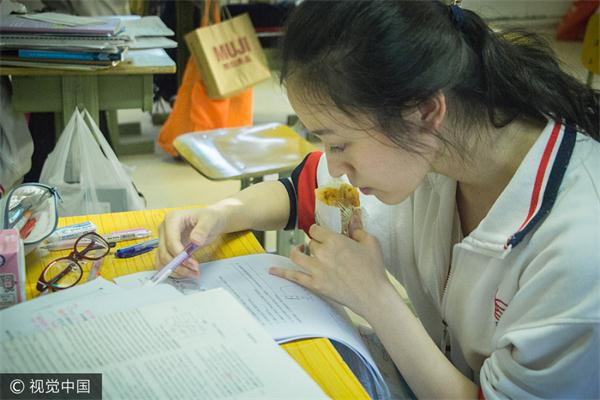 |
A Beijing Chenjinglun High School student does exercises while she has breakfast in preparation for the national college entrance exam known as the gaokao, May 15, 2017. [Photo/VCG] |
Since the 18th National Congress of the Communist Party of China in 2012, Xi Jinping, general secretary of the CPC Central Committee, has spoken about the importance of education on several occasions, highlighting many aspects including fairness in the admission and examination procedures.
Over the past five years, the main aim of China's education reform has been to promote modernization of education governance. The CPC Central Committee's decisions on some major issues for comprehensively deepening reform has focused on provincial governments' education planning and coordination rights, and the importance of schools to function independently and improve their internal governance structure.
The decisions have also focused on streamlining the relationship between public institutions and the education departments, and to improve the management of public schools, scientific research institutions and hospitals.
Education reform has made remarkable progress over the past five years in line with the goal of the overall reform to establish a modern education system. And to help delegate the administrative powers to the schools and extend their right to function independently, a series of administrative exams and approvals, including those for national key subjects, non-academic higher education, educational websites and network schools, have been cancelled since 2014.
As part of the 13th Five-Year Plan (2016-20), the national education development plan released in January emphasizes the importance of the schools' right to function independently-and its specific measures include coordinating and promoting the comprehensive reform of colleges, reforming the review mechanism for granting academic degrees, evaluating the personnel management system in colleges, and improving the methods to assess the professional ranks.
On the road to modernizing the education system, some progress has been made in the construction of college charters. In November 2013, the Ministry of Education approved the release of the charters of six universities, including Renmin University of China. Till June 2015, the Ministry had given approval for the release of charters by all the universities that were part of the 211 University Project (the nationwide key university construction project that aims to build about 100 key universities and a batch of key subjects). This is of great significance to colleges that function according to the charter as well as the law.
According to the Ministry of Education, all colleges and universities in China should establish a mechanism that conforms to the ministry's regulation, and the college charter should be approved by the ministry or provincial level educational administrative departments. Which means primary and middle schools, kindergarten as well as secondary vocational schools will have to prepare similar "school charters".
In general, China's education reform has already made big achievements in delegating the central authority's power to the lower local authorities and local schools, expanding schools' rights of functioning independently, as well as establishing a modern education system.
But still some reforms remain difficult to implement such as the canceling of schools' administrative rankings. The decision to comprehensively deepen reform makes it important for gradually canceling the administrative ranking of schools, in order to further promote the reforms at the next stage.
The author is deputy director of the 21st Century Education Research Institute.