TV journalist helps world tune in to nation's development









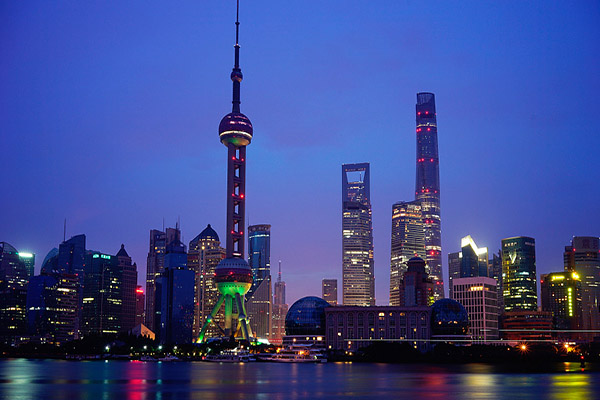 |
| Night view of Lujiazui Financial and Trade Zone of Pudong in Shanghai, July 8, 2017. [Photo/VCG] |
Leonard Pratt's first foray into the world of journalism came when he wrote for the school newspaper at Columbia University in the United States. It was an experience he enjoyed so much he decided to make a career out of it.
"I realized I really enjoyed finding out about things and explaining it to other people," said Pratt, who has since been in the industry for about 40 years.
After graduation, he worked for a number of news agencies, including The Associated Press, before moving to NBC, a broadcaster based in the United States.
In 1985, Pratt was posted to Beijing to lead the NBC team covering China. During his time in the capital, he managed to build a good rapport with his peers at China Central Television, the State broadcaster, while gaining in-depth knowledge about the country.
Two years later, he was promoted to executive director of NBC in Asia and moved to Hong Kong. Despite no longer being based in the mainland, Pratt played a key role in a major media project-it involved NBC, CCTV and Shanghai TV-to produce a 13-hour live broadcast from China.
In 2006, Pratt was presented with the opportunity to help Shanghai 24HMB Medical Information Education create a unique TV program on medical care.
"I found the project interesting because it was a high-end educational program-not something that involved teaching children how to count-and it was vital to improving medical care in China," he said.
"Several of my friends were involved in the investment side of things, and they realized they had the money, doctors and engineers, but not a single person who knew how to create a television program.
"I had previously worked on some projects in Shanghai, and I enjoyed the city. The opportunity to come and work on a good project again was hard to pass on."
Thanks to his efforts, the program was able to help medical professionals nationwide hone and update their skills and knowledge. This program was especially useful to those in remote locations, where access to quality information can be limited.
Pratt joined the Shanghai Oriental Media Group as a foreign expert in 2011. He excelled in his role, receiving awards from the city's Department of Public Information for two consecutive years.
In addition to contributing to the outside world's understanding of China, Pratt has also lent a helping hand to Chinese through the You Dao Foundation, a charity organization that helps the children of migrant workers secure an education.
"Actually, this charity project chose me. I had some friends who were involved and they invited me to help out. I gradually became more interested and involved," he said.
"All the cities in China have a great number of workers coming from the outside, and their living conditions weren't that good. They are in this transition period, it can be difficult for them to find the right school for their children and be able to afford the costs."
For his contribution to the city's economic and social development, Pratt was given the Shanghai Magnolia Silver Award in 2014. He may already be 72, but he still regularly presents on International Channel Shanghai, the foreign-language cable network run by the Shanghai Oriental Media Group.
He pointed out that although China has developed rapidly over the past decades, it is still in the process of opening up to the world, and this means there is still great interest overseas about what is going on in the country.
"Foreign audiences are interested in anything that is coming out of China. There is a still a great deal of fascination with the country, especially in the economic and political areas. The 19th CPC National Congress is coming up and people are going to be watching that very closely," he said.
"For example, we did a report a few weeks ago on fully automated stores in China that have no workers, and it turned out to be an extremely popular story. China is always coming up with new and unique solutions to modern living, and I think people are very interested in finding out more."
What do you feel has been China's biggest achievement over the past five years? What's the most notable change you've observed?
I read a Xinhua News Agency article that said China has lifted many millions of people above the poverty line in the past five years. That's just extraordinary. It's an accomplishment that no other country has managed, particularly on this scale and over such a short period of time. This is probably what China can be proudest of.
What three words would you use to describe China today?
Dynamic. Striving. Self-confident.
What's the biggest challenge China faces, and how do you feel the country can go about overcoming it?
This one is tricky. China has a very old culture, but New China, the China we know today, is a very different country. There are many examples from history of how a new country naturally wants to make itself felt in the world. New China is doing that, which is a good and natural thing. But it involves a challenge-China's neighbors will feel a little uneasy. But the BRICS and the Belt and Road Initiative are examples of how China is looking to work with countries around it, rather than in opposition to them.
Do you believe that some of China's experiences or practices could be used to solve pressing global problems?
Yes, particularly in areas of education and urbanization. I once read that the most effective investment a country can make is educating girls, because educated girls become educated mothers, and educated mothers have educated children. In one generation you can boost a country's technical ability.
There are many areas in the world where people are living on farms and surviving on a subsistence economy. There's very low productivity. When you get these people out of the farms and into an urban environment like China has done-more than 50 percent of the population now live in cities-that makes them more productive and easier to educate.
What do you think China will be like in five years' time?
As everyone knows, we have big problems with North Korea. If those can be solved peacefully, then China has a fantastic future. If not, we're all in trouble. Korea aside, you have a situation where China will rapidly become a premier nation in Asia and in world trade.
What's the most memorable experience or moment you've had in China?
I first came to Shanghai in 1982, and I remember looking across the Huangpu River-there was nothing. It was mud, dirt and some warehouses. Today, when I look across I see an incredible city that has been built in just 30 years.
- China, Russia vow to boost cooperation in Far Eastern development
- China Development Forum 2017
- Xi hopes for greater development of global tourism
- Experience and Enlightenments Drawn from the Transformation and Development of Ruhr District in Germany<BR>——A Trip Report on the Transformation and Development of Ruhr District in Germany(No.70, 2017)
- The Development of Shenzhen's Strategic Emerging Industries during the 13th Five-Year Plan Period: Challenges and Policy Options(No. 84, 2017)