Powerful future awaits digital economy










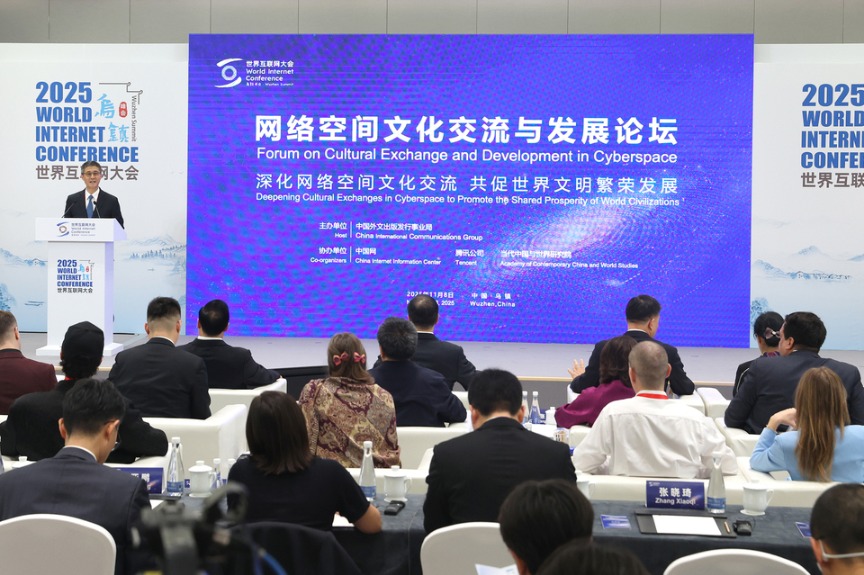
The theme of the 4th World Internet Conference, held recently in Wuzhen, Zhejiang province, "Developing digital economy for openness and shared benefits - Building a community of common future in cyberspace", points to the direction of future global economic development, which among other things requires advanced technologies and a smarter production system.
A country that takes the lead in mastering the core technologies of the digital economy and successfully implements them on a large scale will gain the upper hand in the fierce global competition, because an advanced digital economy can make growth more sustainable and effective, as well as promote research and development in related areas.
Statistics from the Ministry of Industry and Information Technology show that people in the regions where the digital economy has developed rapidly enjoy a relatively high degree of economic growth. And National Bureau of Statistics data show that a 1 percentage point growth in the "Internet Plus" digital economy index will increase the GDP by 140.6 billion yuan ($21.24 billion). For the record, China's "Internet Plus" digital economy index was 161.95 points at the end of last year.
But how healthy is China's digital economy? Authoritative data on 2016 show that China's digital economy accounted for 30.1 percent of its GDP, much lower than those of developed economies such as the United States (59.2 percent), the United Kingdom (54.5 percent), and Japan (45.9 percent).
Although there is still a gap between China and some developed economies in terms of the weight the digital economy carries, China's chase demand strategy has many advantages and a lot of potential. Of course, China's huge total economic output, market size, population and economic growth gave the country a certain "advantage" in rapidly developing the digital economy.
But more importantly, the Communist Party of China and the Chinese government attached, and still attach, great importance to the digital economy, and used their unique institutional advantages to formulate effective industrial policies and accelerate its development. For example, at the Fifth Session of the 12th National People's Congress in March this year, Premier Li Keqiang said in the Government Work Report that both the Chinese people and enterprises will benefit from a fast growing digital economy. It was also the first time the term "digital economy" was mentioned in the Government Work Report.
The report said China's digital economy is making big headway. With data resources as its core elements, information technology as its endogenous driving force, and cross-industrial integration and technical innovation as its typical features, the digital economy has been developing rapidly, and its spillover effect is benefiting other economic sectors to such an extent that they, too, have registered impressive growth.
China is making concerted efforts to elevate its digital economy from a "large-scale" level to one that is "truly powerful, in order to become a leading player in the cyber world in the future. For instance, the "Outline of National IT Development Strategy" issued by the General Office of the State Council, China's Cabinet, says the country will reach the advanced international level in core technological fields of the digital economy by 2020. Also, by the middle of this century, China is expected to become a prosperous, democratic, civilized and harmonious modern socialist country.
And by then, China will have consolidated its network capability and governance, as well as become the global trendsetter for digital economy.
The author is a research fellow at the Chahar Institute and China Institute of Fudan University.