Patience, wisdom can drive e-cars forward









The pace of growth of new energy vehicles in China last year was beyond market expectations with production and sales reaching 794,000 and 777,000 units, up 53.8 and 53.3 percent year-on-year. With 449,000 units sold, electric cars contributed to 80.7 percent of the total sales of new energy vehicles, an increase of 81 percent year-on-year. And the number of new energy vehicles has crossed 1.8 million, accounting for more than half of the 3.4 million such vehicles in the world.
China's e-car industry has made remarkable achievements in the last decade after a number of laws and regulations were implemented in 2007.
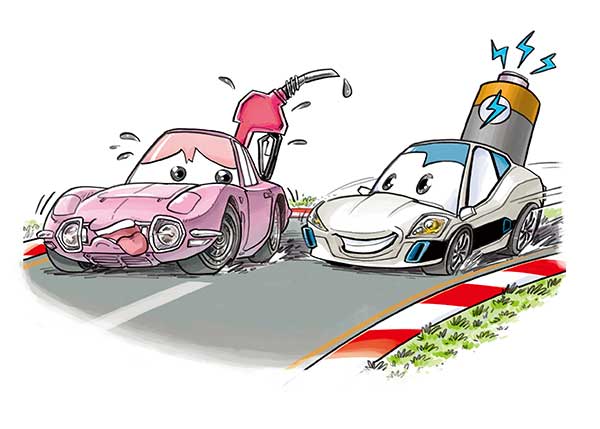
However, there also have been disputes, with the most controversial being on whether e-cars are more environmentally friendly than gas-powered vehicles.
It makes little sense to compare the emissions from two different types of vehicles, as e-cars are still in the early stage of development, and advanced technology will surely make them even more eco-friendly. Also, the functions of battery-powered cars should never be narrowed down to just emission reduction, although e-cars still have more advantages than gas-powered cars when it comes to emitting pollutants.
E-cars emit far less carbon monoxide, carbon dioxide and hydrocarbons than a traditional car. And there has been an obvious regional transfer of pollutants after the development of e-vehicles. For example, emissions of nitrogen oxides have shifted from densely populated urban areas to places with relatively low population densities, greatly reducing the cost of pollution control.
Traditional gas-powered cars are, in one word, bad for the environment. In contrast, with only 10 years of development, e-vehicles have only limited effect on the environment.
But in China, the quality, not the quantity, of e-vehicles should be prioritized. And since competitiveness is the core of industrial development, subsidies to consumers who buy e-cars should be gradually removed. Subsidies, after a certain point, will reduce the development potential of e-cars.
As their prices have continuously declined, e-vehicles in the long run will not be at a significant cost disadvantage compared with traditional cars, unless oil price dip to a new low.
In addition, public subsidy for battery-powered cars could prompt some unscrupulous enterprises to overlook the long-term interests of the industry to make instant profits. The current policy, which does not clearly define and classify products that qualify for subsidies, also leaves room for unlawful behaviors. For example, subsidies are currently given to e-vehicles with long battery mileage, which does not reflect the quality and costs, which in turn could make some carmakers focus on the subsidized parts and produce poor-quality cars in huge numbers, rather than trying to improve their quality.
Therefore, the government should change the way subsidy is granted. First, if subsidizing consumers is still necessary at this stage, the government can learn from the experience of the United States and subsidize car enterprises for a fixed quantity until the quota runs out. Such a policy can prevent carmakers from indulging in illegal behaviors, and force them to improve their core competitiveness by improving the quality of their products.
Second, the government should mainly support the research and development (and innovation) in core technologies, such as batteries for e-cars. As the world's largest and fastest growing car market, China should make technology its main concern in the development of e-vehicles. This subsidy shift can drive car and battery manufacturers to make breakthroughs in technology.
When trains first started plying in the 19th century, people on horses galloped past laughing at the heavy and useless giant behind. Compared with the over 100-year development period of traditional cars, e-vehicles have just completed a decade of development and are still on the ascendant curve. Therefore, more patience and wisdom are needed to ensure e-car development gathers more speed.
The author is the head of the China Institute for Energy Policy Studies at Xiamen University.