California wines go west









Consumer-driven market
Baijiu, a traditional grain liquor consumed by Chinese for thousands of years, has long reigned over the Chinese alcohol industry. Wine was historically used for official events or gifting.
"French wines are well known and have prestige, so they have been most popular among Chinese consumers despite being the most expensive. Exposure to European wine by Chinese tourists traveling in Europe could be an influence," said Fred Gale, senior economist of China team at US Department of Agriculture.
Imports of French wine, however, slowed during 2011 and 2012, when China cracked down on corruption, limiting spending on gifts and entertainment by public officials.
"We saw prices plunge dramatically during that period. French vintners were hit hard because they tend to sell expensive wines," said Tang. "The trend now is value for money as Chinese consumers get to understand wine better."
To Beros, who has lived in China for 10 years, the biggest change over the last five years is the shift to a consumer-driven market. "People are drinking wine at dinner, at home, or with friends. They are doing it for enjoyment, not for showing face," he said.
Imported wine drinkers in China have increased from 19 million in 2011 to 48 million in 2016 in just five years, according to California Wine Institute statistics.
Beros said he believed the trend will continue at a rapid pace for next 10 years, in part because China isn't yet a strong wine-producing country.
Industry insiders attribute the popularity of wine to the rise of the middle class and millennials who are trying to adopt Western culture and lifestyles.
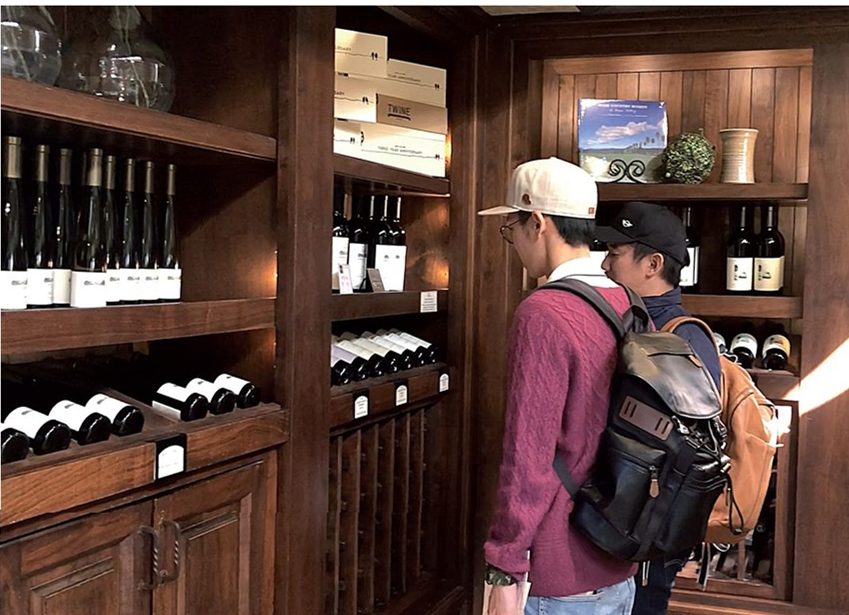
Wineries in Napa Valley are becoming popular destinations among Chinese tourists.
"We really enjoy the beautiful scenery of the vineyards and the setting of the tasting room," said a young couple from Beijing, who gave only their last name Xie.
"It's common for tourists to take a couple of bottles back home. California wines are not easy to get in China," said the husband, while shopping at the gift shop of Robert Mondavi Winery.
"There's really great attention to wine education. People start to enjoy wine and understand wines more rapidly," said Emilie Steckenborn, a Shanghai-based host of a foodie podcast "Bottled in China".
"I think the (Chinese) understanding is not there yet, but it's coming because you don't want to be the last big thing. You don't want to be drinking something that nobody drinks anymore," said Steckenborn, also a wine consultant for China Eastern Airlines.
"Maybe Old World wine is an older thought model. New World wine is a lot more acceptable to young people."
While California wines struck the Shenzhen delegation as high quality at all price points, they said they are not cheap.
Many American wines are competitively priced and are of strong value, but they are less competitive with wines from Chile or New Zealand, which enjoy free trade agreements with China, said Gale. "In contrast, I think Australian wines have a price advantage over US wines," he said.
But California vintners see potential in Asia, especially China.
"People are more interested in fine wines. Because the US has never had cheap wines, we were at disadvantage six or seven years ago. But now as the market is going up, we are at an advantage," said Beros.
The year 2016 saw a 47 percent increase in the value of US wine exports to China, coupled with an 11 percent increase in volume, which represents a meaningful growth in higher value products, according to data from the California Wine Institute.
In 2017, the exports to Chinese mainland were flat while exports to Hong Kong were significantly up.
"About 30 percent of the wines going to Hong Kong are re-exported to the Chinese mainland, so we're seeing our wines very strong in the greater China market," said Beros.
Despite the increase, US wine represents only 1.6 percent of Chinese wine consumption. China's wine market is forecast to reach $22 billion by 2020, surpassing the UK as the world's second most valuable wine market after the US, according to the International Wine & Spirit Research (IWSR) organization.
Lack of promotion for US wines plays a part in the small consumption in China, said Tang. Throughout the year, master and sommelier classes of French, Spanish, Portuguese and Australian wines are available to professionals and wine enthusiasts, but he said he has never heard of US wine-education classes.
The US wineries don't feel much of a need to export since almost all the wine they produce is consumed domestically, Beros explained. France, the world's biggest wine producer, exports 35 percent of what it produces. In Australia and Chile, the numbers are 60 percent and 80 percent.
"But many of them who actually could sell wines in the US still want to do exports because they're trying to build an international brand," said Beros. "China is the only market in the world that's growing."
Robert Mondavi Winery has made the Chinese market a key focus starting three years ago, said Camille Zanette, the winery's manager of international sales and marketing operations.
"We tell stories of the winery's history and how Mr. Mondavi inspired the industry through our WeChat platform. We also invite masters of wine to give classes and participate in trade events," she said.
Wine education
Chen sees wine education as an effective channel to raise awareness of US wines in China. Next month, the Shenzhen Wine Industry Association will send another delegation to California on a mission to introduce California wine education programs to China.
Shenzhen, China's first "special economic zone", started importing wines in 1980 and has since dominated the country's premium-wine importing business.
"It's the wine importers' job to make money. Our association's strategy is to promote the US wine in China," said Chen. "If the imports (of US wine) rise to 5 percent, it will mark considerable growth.
"The more wines we import from the US, the better the US farmers will understand China. We hope to contribute to the US-China relationship through wine," he said.
Klinker Brick is one of some 150 wineries in California exporting around the world.
"Not every winery in California wants to export, but we feel it's a great opportunity to export to different regions, especially China, because there's a lot of excitement about wines," said Felten.
Now she is considering her first trip to China. "I'm excited to bring my family's winery into China and show what Lodi can do in the bottle."
Contact the writer at liazhu@chinadailyusa.com