


Crossroads of cultures









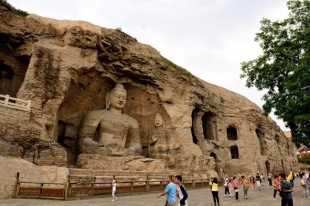
The rulers of the Northern Wei Dynasty created the Yungang Grottoes as a way to unite China's war-torn ethnic groups under Buddhism.
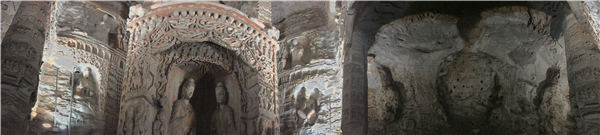
Even for those who are not interested in Buddhism or sculpture, when they first arrive at the Yungang Grottoes, they can't help being touched by the perfect combination of religion, arts and nature presented to them.
It takes about an hour to give a hurried and cursory glance at the grottoes that stretch for about a kilometer along the southern slopes of Wuzhou Hill, which lies 16 kilometers west of Datong in North China's Shanxi province.
But the lines, colors, angles and shadows that the grottoes present will linger for a long time in the memories of the tourists that visit them long after they return home.
The many comments by the buyers of books about Yungang have prompted curious minds to read more about the cultural treasures on the border between the Loess Plateau that lies to the south and the Mongolian Plateau to the north.
The royal families of the Northern Wei Dynasty (386-534) started to build the Yungang Grottoes in 460, and the project that had entailed national resources right through until the fall of the dynasty founded by the Xianbei, a nomadic people from the northeast of Asia.
As one of the four greatest ancient grotto complexes in China - Mogao, Maijishan, Yungang and Longmen - Yungang takes an important position in history because it marks the beginning of Buddhism's spread into Central China.
Built in 366, the Mogao Grottoes are located in Dunhuang at the western end of the Hexi Corridor, while the Maijishan Grottoes were built in 384 in Tianshui, at the eastern end of the corridor. The Yungang Grottoes built on the northern border of Central China retraces the footprints of Buddhism on its eastward journey from South and Central Asia.